Year of the Cub!
I've just returned from my annual spring pilgrimage and photo tours into the Khutzeymateen Grizzly Sanctuary on the northern coast of BC (Canada). Each year the grizzlies provide photographers and wildlife lover's with unforgettable experiences, but this year was particularly special. In spring 2013 there was a bit of a paucity of female bears in the Khutzeymateen, and we hoped it was because they had all had cubs and were keeping their small cubs-of-the-year out of the area due to the high density of bears (the large males will kill the cubs, so it's not a good idea to bring the little ones in). There were other less positive explanations for the missing females (such as them being killed by poachers or trophy hunters), but we were relieved and thrilled to see them all back this year with yearling (2nd spring cubs). We had several mother and cubs to work with and 2014 will definitely go down as the "Year of the Cub" for the Khutzeymateen. With luck many of them will be back as two-year olds in 2015.
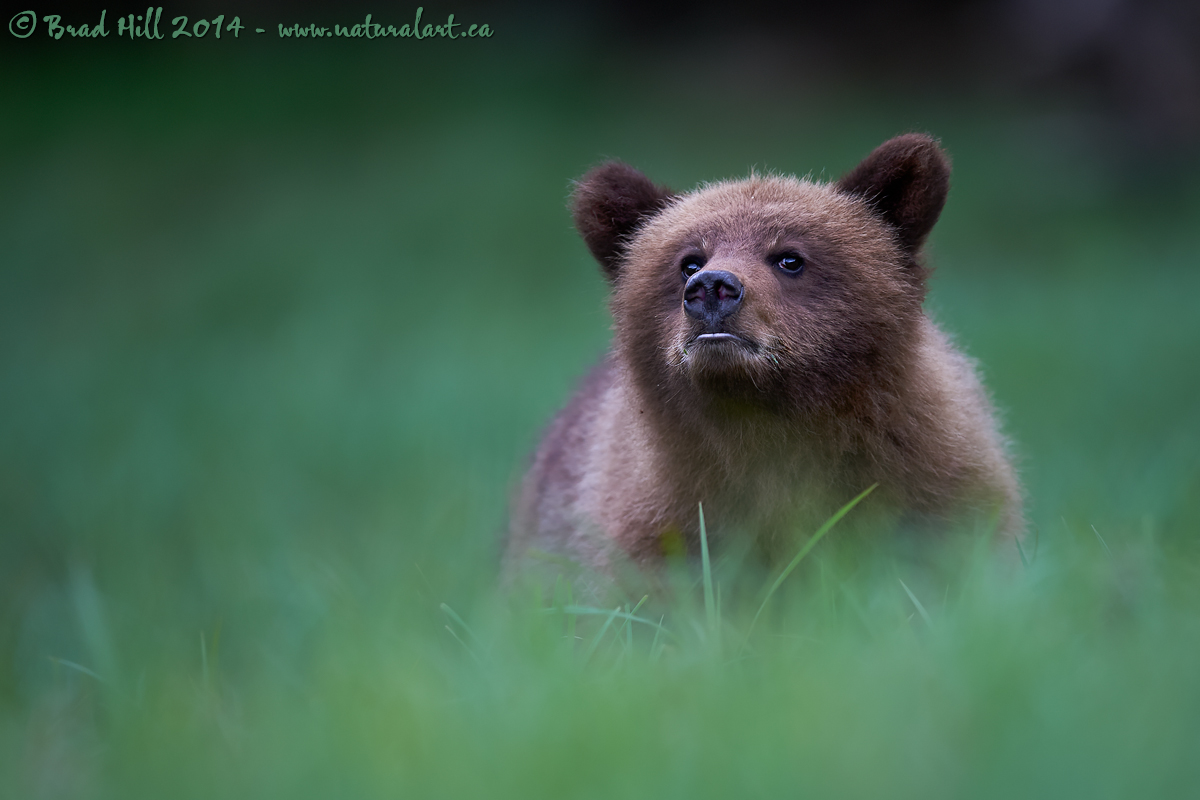
The shot shown above is of a yearling cub (in its second spring) exploring a grassy knoll while cautiously checking out the strange grey creature (our zodiac boat) that's sitting just offshore. All sensory tools - nose, eyes, ears - are fully engaged and helping the cub determine if we're friend, foe, or simply something that can be safely ignored. I intentionally shot directly through grasses that extended up to the cub's mouth and chose a very wide aperture (f3.2 on my 400mm f2.8 VR) to produce the soft look of the image (and to help make the cub just pop out of the screen). While this "technique" is mostly equipment-driven (it would be impossible to do with a f4 or f5.6 lens) and not particularly unique from a creative perspective, finding the exact right situation where it will effectively work with a wild subject is a fairly big challenge in itself. As this "scene" was developing I saw that my proximity to the grasses in the foreground (very close to me), the distance to the grasses in the background (distant, largely owing to the fact the cub was near the top of rise that fell away behind it) and the angle of the cub coming at me all added up to the exact right situation to go for the soft, shallow DoF shot.
Those that know me and my photographic style and skillset or who closely follow this (or my) website are likely aware that I am reasonably proficient at post-processing of digital images. That doesn't mean I take extreme liberties with my shots (I almost never clone anything other than dust specks from an image, don't make extreme enhancement to color saturation, etc.). But I do often put a LOT of work into balancing and tweaking an image's exposure and contrast. But with this image - well...it's straight out of the camera! All I did with this image was export the image from Lightroom to my preferred raw converter (Capture One Pro) and hit the "Process" button. Ya gotta just love it when that happens!

Subject: Young grizzly (
Ursus arctos) cub
Location: Khutzeymateen Inlet, northern Great Bear Rainforest, BC, Canada
Camera: Nikon D4s
Lens: Nikkor 400mm f2.8 VR - hand-held from floating zodiac. VR on and in "Normal" mode.
Exposure: 1/500s @ f3.2; ISO 224. -0.67 compensation compensation from matrix-metered exposure setting.
Crop: Very minor- this is about 95% of full frame
A lot more details about this image - including including a much higher resolution version (2400 pixel) - can be found here on my website:
http://www.naturalart.ca/galleries/latest/.
Comments and critiques welcomed - probably best to view the larger version prior to doing so!
Cheers...
Brad
PS: Like all wildlife images on my website and that I post on NPN, the subject is fully wild and completely unconstrained. Besides the potential impact of my presence, nothing has been done to intentionally alter or affect the ongoing behavior of the subject and, of course, there has been no use of any form of bait or other form of wildlife attractants (including vocalizations)

Comments
16 commentsGlad you like the shot. On the OOF area in the foreground - glad you mentioned that. I don't mind out-of-focus foregrounds per se, but what I'm not fond of is multiple out-of-focus zones (one in foreground and one in background) that have a distinct in-focus band running from edge-to-edge across the central part of the frame. I find having these three distinct focus "bands" quite unappealing (but this is obviously a subjective thing) and I think it looks just too unnatural for my taste - and it screams "long telephoto in use" just too loud. The easiest way to avoid the "focus banding" is to ensure that the foreground and subject is in focus, and the background is out-of-focus.
And...pulling off out-of-focus backgrounds AND foregrounds while avoiding the "focus banding" thing is possible, but it's certainly not too easy in a field setting. The trick with having both out-of-focus foregrounds and backgrounds is to have them appear continuous and thus as one single out-of-focus zone. In this image you really have only two focus zones - the in-focus subject and then everything else (i.e., one out-of-focus zone). On this one all conditions were just right to allow me to pull off the continuous OOF zone scenario.
Hope this makes sense...
Cheers...
Brad
Jim
Very choice image and the narrative works for me. I like the composition, soft lighting, and the OOF grass in the foreground.