Milky Way and Mesa Arch
by Roger Clark
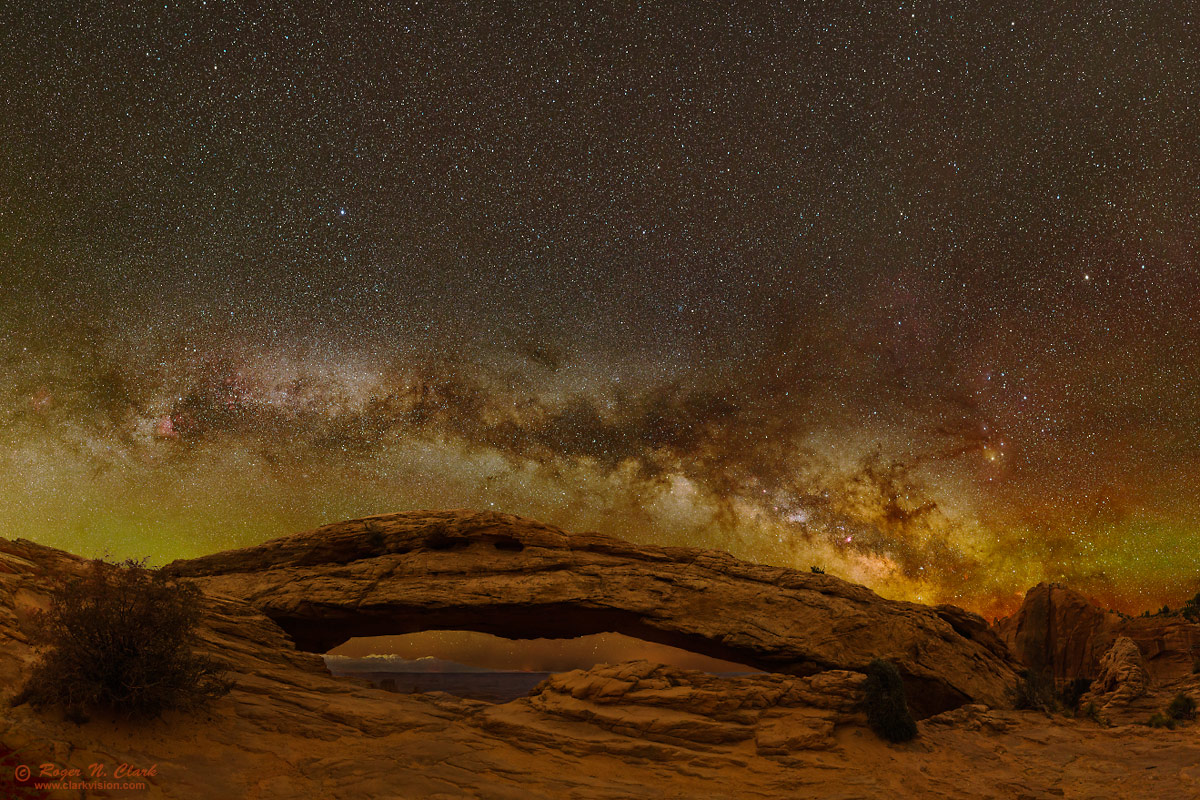
The Milky Way rises over Mesa Arch in Canyonlands National Park, Utah about a week ago. The center of the Milky Way and the constellation of Sagittarius are on the right side of the arch, and the Constellation Cygnus is above the left side of the arch, with the red North America Nebula.
This scene is all natural light: the light of the night sky includes stars and nebulae shining on the landscape. Other light is red and green banded airglow, most prevalent near the horizon on each side of the arch. The red+green airglow imparts a warm yellowish light on the landscape. No artificial lights were used to illuminate the arch.
Canon 6D 20-megapixel digital camera, Sigma 35 mm f/1.4 lens at f/1.4. Forty two exposures at ISO 1600 and 6400 were made for the mosaic. On the sky, the camera tracked the stars using an Astrotrac, with 29 exposures, 30 seconds each, ISO 1600, then 13 images with 60 second exposures of the land were made with no tracking, with ISO 6400 and 1600. The land includes multiple focus points to allow focus stacking for improved depth of field, making a sharp foreground as well as sharp sky.
A larger image and more details are at:
http://www.clarkvision.com/galleries/gallery.nightscapes/web/mesa.arch.mightscape.rnc05.02.2014.IMG_1685-1742.g-bin10x10-c1s.html
Roger

Comments
16 commentsSecond, thanks for the info on the red/green airglow. I actually toned this down in my MW shot; I thought it might be the lights of Vegas in the far distance.
Third, were your sky exposures stacked for clarity and noise reduction, or were they stitched to make a higher pixel image?
Thanks for all your knowledge Roger; great work!
No stacking on the sky, only stitching them into a mosaic. I also do not do any noise reduction--every noise reduction O have seen deletes faint stars.
Roger
Glad to see you posting here and looking forward to more...
Love the echo in the comp and all the pinprick stars.
Has been very interesting reading your comments on the night photographs on here. Out of interest, what white balance did you choose for this photo?
White balance = sunny
Admittedly I'm having a hard time getting used to the strong green and red tones in this image. I read the article about the color of the night sky on your website. I suppose the difficulty is due to the fact that we do not perceive the sky this way due to the limited sensitivity to light that we have. It's just one more way the camera sees differently than we do. It will definitely be interesting to read others' comments on this.
Overall this is an excellent image. Thanks for sharing your creativity and expertise.
I agree with you about the sky and cropping to more of a panorama format in a web presentation. This does not come across as well in the small web images, but the stars and detail in the sky above the Milky Way is amazing in higher resolution. The full image will make a 44x32 inch print at 300 ppi, which is what I intended the image for.
Roger
What I would give to see this printed large, in person...
The red and green colors near the horizon are not from cities. The typical city produces a characteristic orange glow. The red and green colors in this image are from airglow. This is a process like polar aurora. The polar aurora are cause by solar protons and electrons hitting molecules in our upper atmosphere. Airglow is from solar ultraviolet light hitting the same molecules (of course in the daytime). The emission lines are the exact same wavelengths. You've probably seen aurora pictures of red and green aurora. The airglow is the same colors. Airglow is always present at some level, even in equatorial regions. Just it seems digital photographers these days are rarely aware of it as they typically color their night scenes blue so these colors don't show. Imagine if all those polar aurora photos were colored all blue!
Roger