Savannah River Port
by Philip Hodgkins
The Port of Savannah (Georgia Ports Authority) is the 4th largest container facility in the U.S. They also have RORO (roll on, roll off) facilities for car, earth working and agricultural equipment; and breakbulk and reefer facilities for import/export of wood products, refined sugar, kaolin, chickens, recycled steel, etc. It is a huge and very busy port.
The Savannah River has been in continuous use since Oglethorpe founded Savannah. Its original depth was 17 feet, average, at mean low water. It has been dredged, widened and straightened for the last 200 years. Accompanying environmental issues have been myriad during that time: loss of freshwater tidal wetlands (originally 12,000 acres, now 4,400); fish kill from oxygen deprivation (from pulp mill waste water, industrial and community waste, etc.) Numerous other conflicts have marred its existence: economic, environmental and political. Much time and effort has been expended in recent years to bring the river and associated wetlands back to a better condition, if not their original condition.
The latest hot button issue has been a recommended dredging, deepening the inner harbor to 47 feet and the entrance channel to 49 feet; extending the entrance channel by 7 miles; constructing three bend wideners and two meeting areas; and enlarging the Kings Island Turning Basin at the Garden City Terminal. All of this is to accommodate the super container ships that will be coming through the Panama Canal by the end of this year. The price tag on this is $660 million. This does not count the cost of aerators for the river, maintenance of the bottom and contingency plans for quick resolution of unforeseen consequences.
No one knows for sure what those consequences may be, but chances are the project will be a go.
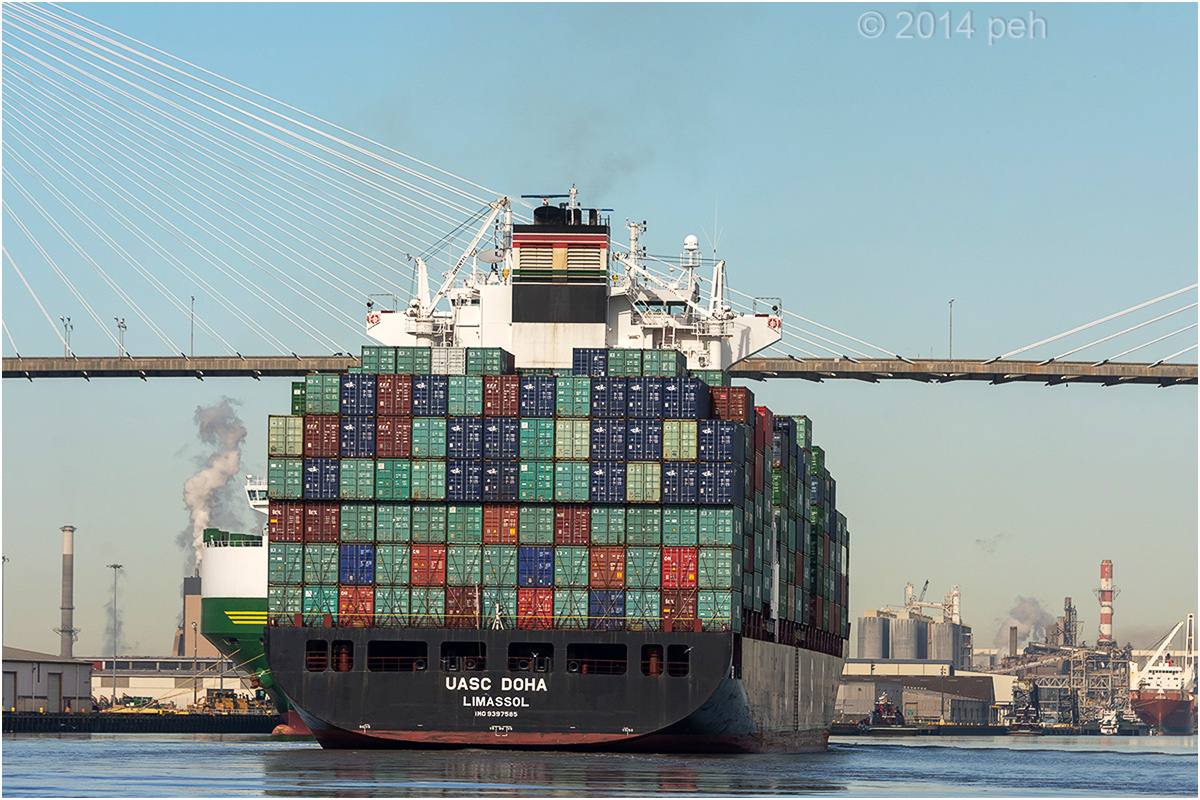
The container ship shown, the UASC Doha is registered out of Cyprus. It has a fully loaded draft of 41.4 feet, although it is probably drawing about 34 feet with this load. The bottom here on this side of the Talmadge Bridge is 45 feet, just after high tide, when she came to the bridge. Further up the river it drops to about 41 feet. It will take a full day to offload and reload. Naturally, these vessels want to come and go as near high tide as possible.

Comments
4 commentsThen, I also thought from the perspective on your image that UASC Doha was going to take out the bridge, so maybe there's hope after all
Posting images like this with their background stories can only help
I especially like the industrial complex BG, and suspension bridge that splits the frame.
Well composed - Well done!