WC610 - Monster Cricket
by Randy Runtsch
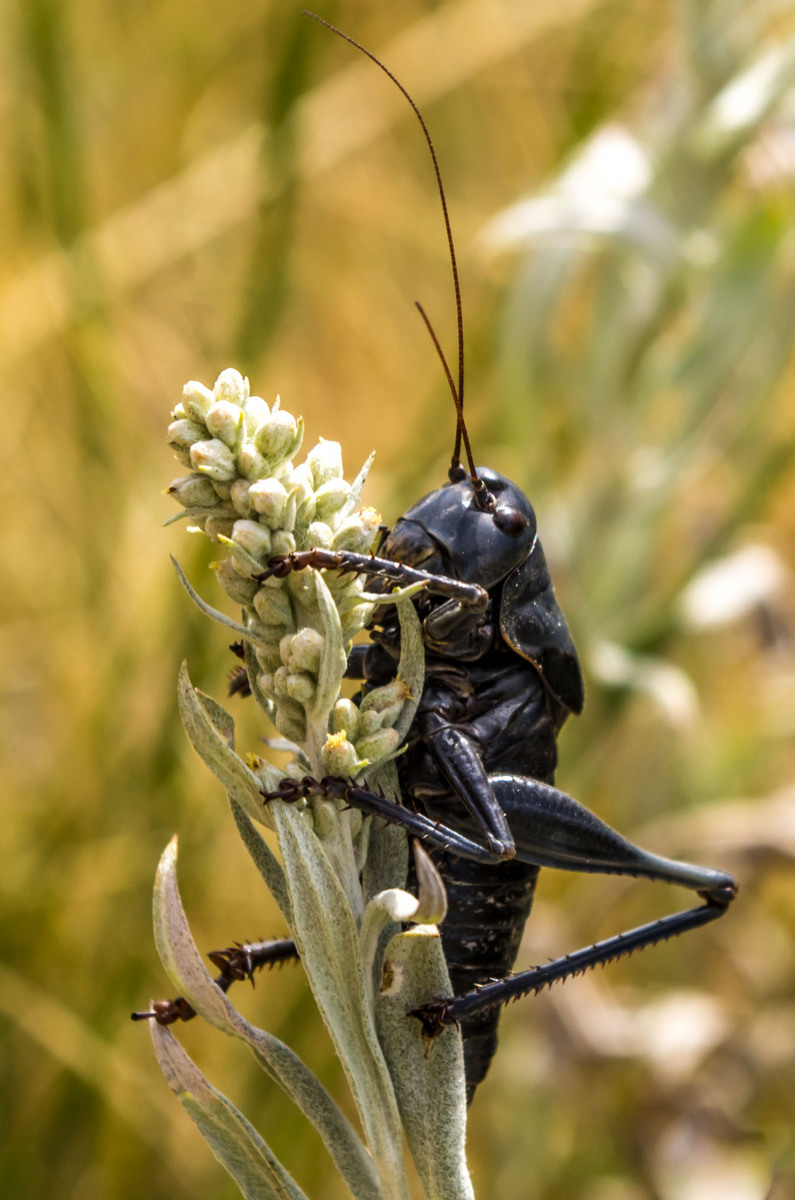
As my son and I hiked to Hell Roaring Creek in Yellowstone National Park in August, we passed through a meadow filled with the biggest crickets we had ever seen. While gentle and easily handled, these black creatures were about 2-1/2" long. Many specimens posed patiently for me to take their portrait.
Pentax K-5 with DA 18-55 WR at 55mm, 1/90 sec, F/9.5, iso 200

Comments
12 commentsI think that this creature is neither a grasshopper nor a cricket, but a katydid. It is commonly called a Mormon Cricket, unless I am mistaken (and I may be): http://en.wikipedia.org/wiki/Mormon_cricket.
Perhaps grasshoppers, katydids, and crickets are like butterflies and moths: there is no real known scientific distinction between them. These grow up to 3 inches long.
"A rose by any other name..."
Good info on its classification, too. The common names cricket, grasshopper and katydid (like many common names versus scientific names) can be confusing. They are all in the order Orthoptera, The two main sub-orders of Orthoptera -- Caelifera (mostly grasshoppers and locusts, which have short, rod-like antennae) and Ensifera (mostly katydids and crickets, which have long, thread-like antennae) in fact are good scientific classifications. However, the common names of some of the families in those distinct groups can be confusing, since people have given many insects common names that don't comply with the scientific classification, such as your "Mormon cricket" and names like "long-horned grasshoppers."
As far as butterflies and moths are concerned, however, it seems that there is more agreement in common names than in the scientific classification (go figure). Overwhelmingly, people call Lepidoptera with clubbed antennae (including skippers, which have threadlike extensions on their "clubs") butterflies. On the other hand, Lepidopterans with thread-like or feather-like antennae are generally considered moths. (It's not that insect taxonomists are not precisely classifying them, but there are at least two schools of thought regarding how to lump or split the larger subdivisions such as suborders.)
This past summer my wife asked me why I like to photograph insects so much. I answered that they I consider them among the most fascinating and unusual subjects around.
I am finding NPN and its helpful members to be a fine and friendly set of learning resources.
YOUR QUESTION ABOUT INSECT INFO ON THE WEB AND IN BOOKS:
WEB SITES: http://bugguide.net/ is a great collection of photos that help ID insects, but people not familiar with insects can be mislead if they just use the pictures to try to ID a species. Many, many people find a photo that looks pretty much like an insect they saw, and assume that it must be that one. However, they could be looking in the wrong family or even the wrong order. EXAMPLE: One NPN post showed a longhorn beetle that is a wasp mimic (evolved to look like a wasp to avoid predation). Some members found one of several wasps with color patterns similar to the beetle, and assumed that was what it was, because they went by general appearance instead of the basic body structure. It's possible to avoid that kind of error by starting at the beginning of the "Guide" and tracking your search step-by-step through the class, order, and family. However, that can be confusing if you don't already know something about those larger classification levels. To to that, I suggest taking some time with a book to learn about the different ORDERS of insects. (bugguide.net only has a few pictures for each order, but no text explaining anything about the orders of insects.)
BOOKS:
1. The original best insect book: I don't have many of the newer guides because I studied entomology SO many years ago in college. The main entomology textbook I used in the 1960s (newer editions, of course) is still the gold standard for identification of insect orders and families. But it's very big and expensive, and it relies on complicated keys to find insect families, instead of photographs, so it's better suited to scientists than more casual insect fans. If you are interested, it is
An Introduction to the Study of Insects by Donald J. Borror and Dwight M. DeLong.* Hey, I just Googled it, and it looks like you might be able to download it as a free e-book from a Web site called Bookbee.org. HOWEVER, I don't know if this is a legit deal (they want a credit card number), so I can NOT vouch for it. In any case, simpler books may be more useful....
2. Modern Insect Guides: Again, I am not familiar with all of them, so yours may be very good. One that I like is
National Wildlife Federation Field Guide to Insects and Spiders & Related Species of North America by Arthur V. Evans. Like most field guides for insects, it only lists the most common and showy species that people are most likely to notice, so it's easy to assume you have found the right species, when there may be dozens of others that look a lot like it, that are not mentioned, but this book is better than most. The thing I really like about it is that it has excellent introductory chapters that explain the orders of insects and related classes of arthropods. On top of that, every section dealing with each order has a nice overview of that order. That's GREAT, because knowing the orders of insects is the real key to learning insect identification. (Hopefully your book, and others are also helpful in that respect)
I hope this helps! You are right! Insects are not only the most numerous and diverse animals on this planet, they are also the most fascinating. GOOD LUCK!
**********************************
* Addendum: The latest edition of the Epic Borror and Delong textbook is: Borror and Delong’s Introduction to the Study of Insects 7 th Edition written by Charles A. Triplehorn and Norman F. Johnson. Shopping for it is confusing. The new (7th) edition costs more than $200, but there are lots of used older editions for sale at low prices. I saw some "free" PDF downloads offered, but they may be illegal copies of old editions, and the offers I saw were VERY suspicious, asking for credit card numbers, requiring you to download software that may be full of DANGEROUS malware and viruses! I would not click on any of those scams!
Did anyone mention mole crickets? If so, I missed it.
Are you referring to the fact that Randy said that the Mormon cricket he photographed was actually a Katydid? Both katydids (which look and behave somewhat like grasshoppers, but are indeed in the suborder Ensifera) and also crickets of various kinds are included in the suborder Ensifera. Ensifera include thousands of diverse species, from tough, bony-legged burrowing insects like the mole crickets, to thin, delicate jumpers that look a lot like grasshoppers, except for their long, thread-like antennae. The classification is not that complicated, but the common names people give some of these insects can make it confusing.
THANKS for suggesting this Weekly Challenge, Lucy! It's lots of fun. I hope we get many more posts.