Moonlit Rock
by Serkan Imisiker
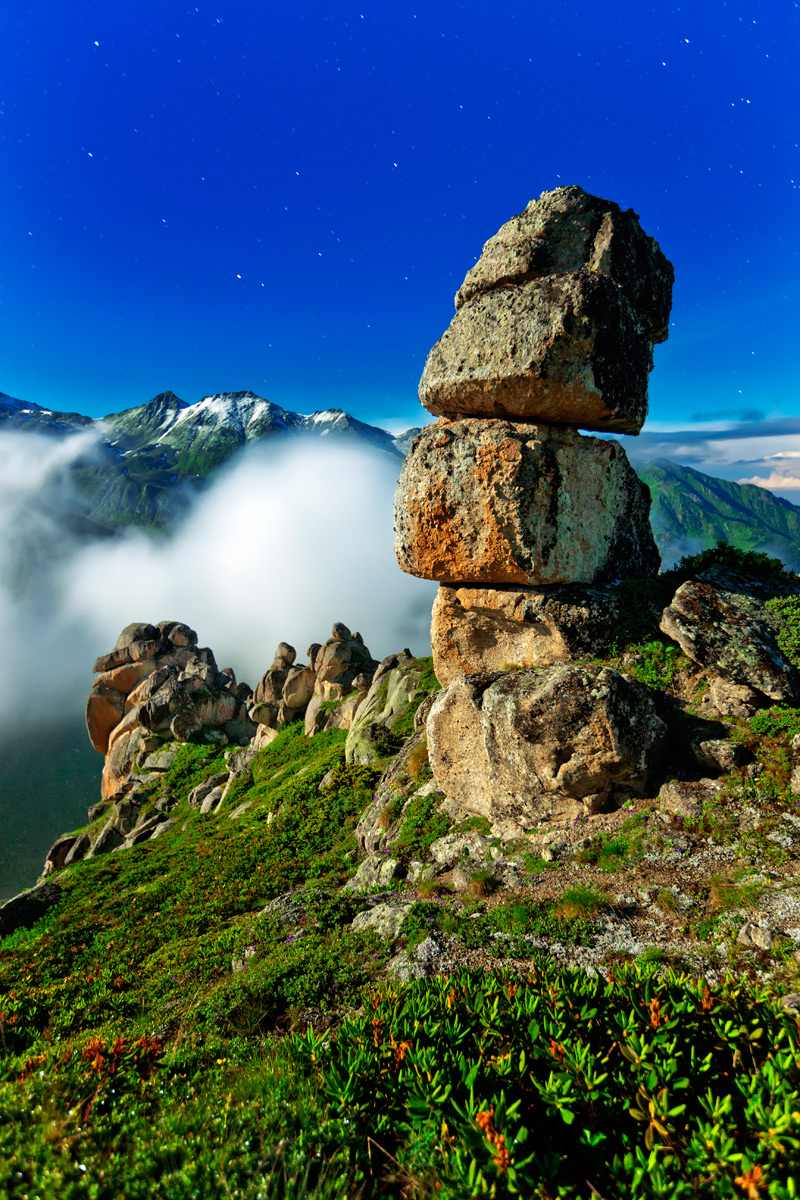
When we were traveling around the Kackarlar National Park to find a suitable place for camping and moon light photography we discovered these interesting rock formations at about 3000 mt. altitude. It was 1st of July but we experienced a light snow fall on that day. We were a few days away from the full moon and the rocks were lighted by the moon from aside.
Kackarlar National Park, Rize, Turkey.
Canon 5D Mark II, Canon 16-35 Mark II at 20mm, 46 sec., F3.2.

Comments
10 commentsAn interesting first post. I really like the composition, a cool formation and some great atmosphere!
Shooting with moonlight is somewhat a matter of personal taste, some folks will love the idea and others will just be baffled by it. I have no problem with the concept, but for the results here i fall in the latter camp, because it doesn't feel consistent to me, and i believe that art/photography should be consistent. The foreground looks identical to a (relatively saturated) typical daylight foreground. The sky here is completely identical to a daylight sky, same color and brightness, the only difference is that there are stars visible. So, the question that immediately pops in my head is, Why? Is it to create a surreal landscape with stars? Or is it meant to evoke the feeling of being there in the moonlight? If it were the latter, then my strategy would have been to go much darker overall, to be consistent with the night time atmosphere. So, I assume it is the former, but welcome your thoughts on the subject. I'm just not crazy about the night-as-day look.
Look forward to more from you!
Truly an interesting rock formation and a great subject to work with. Makes one wonder how these things in nature take place and seemingly it is not surrounded by bigger rocks that we can see in this image anyway.
I was surprised at how light the image is from just moon light, almost looks like normal daylight overall. The stars provide insight to the TOD of it being nighttime, but I'd expect the sky to look different overall. Not sure it it is the lightness or the color, or both.
Well this is an interesting first post and we look forward to more in the future.
Foreground was lighted by the very bright moon situated at the left hand side of the photo. But I suspect that some twilight might effect the right hand side background, that is the way of sunset. I am aware of your concerns but the image consists of only one image and I did not blend for the stars.
Cheers.
Apart from the pleasing formal aspects of the composition, I notice the overal color saturation which is on the high end to my perception, but there are some nice contrasts of yellow and blue, red and green. In form and texture, I love the excellent sharpness (accentuated by the hard shadows from the distant, tiny, single-light point-source) contrasted with the extreme softness of the clouds in the valley and the emptiness of the sky, with the exception of distant point sources of light.
As to the central subject, anyone who has hiked probably has seen rocks stacked on top of one another -- by other hikers as a sign to others that they were there, because this isn't something that would occur naturally. This subject reminds me of that, except that this formation, while we realize it came about through erosion, could also be interpreted metaphorically as having been arranged by cosmic forces to inform us of their presence.
About three quarters of the total mass in the universe at this moment is though to be hydrogen, the simplest element. So I also see here a linkage between what we see in the image of the present moment as represented by the evanescence of the clouds and the ephemeral lives of the plants and flowers, through the longer-term history implied by the subject rock formation, back yet further to the formation of the mountains, and then further still into the stars, which turn hydrogen into the heavier elements, and depths of empty space back to the beginning of everything.
When we have spent a long time looking at more traditional landscapes, this images does initially have a more surreal feeling to it. But then I find myself stopping to ask what is real and why should what is immediate and habitual be the only standard of "real"?
The color is suspect.
I use Nikon's Capture NX2 or Phase One.
Can you change the Kelvin temp and play with that for some type of effect.
Also the red, blue, green after the selected temp.
Interesting challenge.
the fisch
But after all, this shot was taken with a very bright moon light and the ambience was quite similar to what you see in the first place. It may look surreal at first but it is something real.