Puppy Dog Eyes!
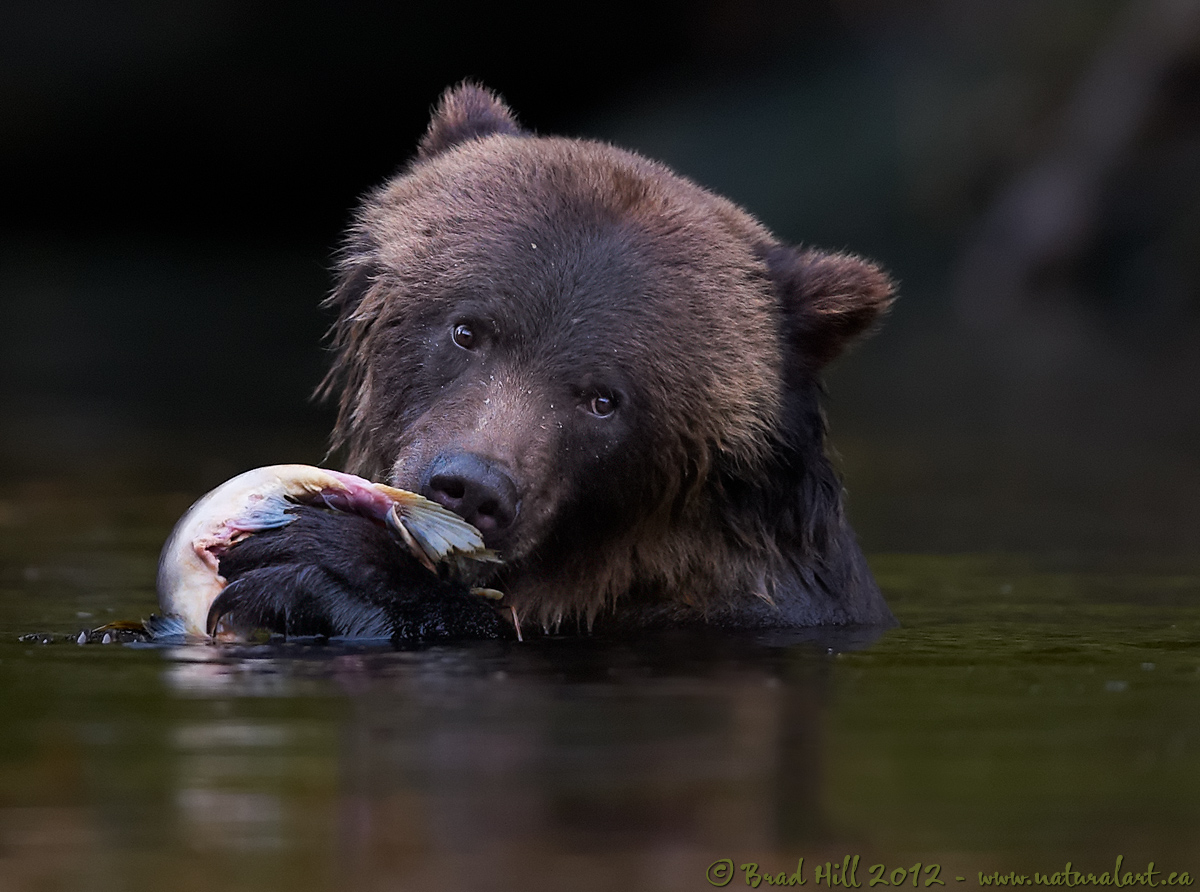
I recently post an image of sleeping bear and someone (who shall remain nameless) commented on the fact that they wished they could see the bear's eyes. So...Jerry...this one is for you!

One way to make your viewers really relate to your wildlife images - and to get them to stop and take the time to give them a good look over - is to give your subjects some personality. That's easy to say, but tough to do with wild subjects in a field setting. But something to keep in mind is that many viewers get "hooked" when you capture an image that is somehow reminiscent of either something "human" (so think "anthropomorphic") or something they can really relate to - like the expressions of their pet dog or cat. And often to do this the eyes are the key...ya gotta watch your subject's eyes!
Do bears (or wolves, or lions, or whatever) have actual and individual personalities? Well...it's hard to get to the bottom of that question without a lot of debate. But the reality is that in the end it doesn't really matter if they do or not. BUT, what is important is to make the viewer THINK they do. Especially if you want to convince someone...through your photography...that, for instance, a wonderful place like the Great Bear Rainforest is worth saving - and protecting it from having oil supertankers ply though its narrow channels and inlets - simply for the sake of the bears! How do you do it? Be patient...shoot selectively...watch for great expressions on your subjects...and watch your subject's eyes!
I've shown this shot during many slideshows and it almost never fails to draw an "AWWWWW..." from the audience. At the instant in time when I captured this image this bear did give off a "cute, cuddly, shy" aura and it was most endearing. This WAS a gentle bear and in my view it DID have the personality this image suggests. But maybe I'm just imagining things. But if your audience imagines the same thing...well...you've done your job as a photographer!
Oh...and if I haven't mentioned it - watch your subject's eyes!
Subject: Female Grizzly (
Urus arctos) peacefully enjoying a salmon dinner
Location: Great Bear Rainforest, BC, Canada
Camera: Nikon D3s
Lens: Nikkor 400mm f2.8 VRII lens - hand-held from floating zodiac. VR on and in "Normal" mode.
Exposure: 1/250s @ f2.8; ISO 1600. -1 stop compensation from matrix-metered exposure setting.
Crop: Significant - this is only about 65% of original image
Additional details about the image (including processing details) available here:
http://www.naturalart.ca/galleries/latest/detail_2.html.
Comments and critiques welcomed - probably best to view the larger version prior to doing so!
Cheers...
Brad

Comments
16 commentsI'd welcome your thoughts on why you chose to crop this way. I don't have a problem with it, but there were obviously some options for you. Some folks may have cropped tighter from the bottom, others may have left more of the water and reflection. Yours is kinda in between. Since you're always thoughtful in your explanations I'd love to hear your reasoning for going this route. It's a subtle choice, but not one I think everyone would opt for (I'm not even sure how I'd go about it, honestly).
Max
Another great shot, as we have all come to expect from you! Between the two of them Jerry and Max just about summed up my feelings- every single shot you share has something that makes it exceptional, I never see just good shots or ok shots coming from you! And, as Max hinted at, from my (limited) experience photographing bears, they are pretty tough animals to get great shots of the eyes, yet you seem to do it repeatedly.
I would also be interested in hearing your thoughts on the composition question Max brought up. I think were it my shot I might have cropped much of the bottom off, yet I still really like it as is.
-Cam
Couldn't agree more with you.
Jagdeep Rajput
Beautiful photo Brad!!!
Ken Archer
Thanks for the feedback - much appreciated. This shot has always worked for me on an emotional reaction - my first reaction to it whenever I bump into it is still "AWWWW". ;-)
A few specific responses:
1. Jerry: Glad you approve! I was tempted to post a shot I have of a Spirit Bear asleep with one eye open (in response to your "like seeing eyes" comment) but figured this one had even more compelling eyes…
2. Lon: "Coquettish" eh? I guess I can kinda see that. But I want to make it totally clear that she's far too hirsute for my personal taste…
3. Max (and Cam): On the crop choice…lots of variables there - and, like any compositional issue, always a mix of "tried and trued" guidelines mixed with gut feel and some things that are important to me. Here's some of my thinking that went into the crop:
A. I wanted it tight enough that good detail was retained, especially in the eye and snout region. In a perfect world I would have liked to have shot this with my 600, but it wasn't in my hands when this happened and light was kinda low for a 600 f4 (this was shot wide open at f2.8 on my 400 - between having to bump shutter speed a little to hand-hold with a 600 and the smaller max aperture I likely would have been up to ISO 6400).
B. I wanted an aspect ratio where a diagonal from top left corner to bottom right corner was very close to parallel to the implied line connected the two eyes (and connecting the two ears). Weird thing? Perhaps. But I think things like that are subliminal and make a difference to how an image is received (even if the viewer doesn't know it).
C. Amount of foreground: Given the diffuse nature of the reflection (and there's darned little of it left that is discernible below the bottom of the frame), I didn't feel it was important to include more of the reflection. Yet, I wanted to position the bear a little further back in the frame (to give it depth) and including that much foreground also helped accentuate the low angle it was shot from. I personally think "depth positioning" (kinda the 3D equivalent of positioning relative to the sides of the frame) - and the impact it can have on a photo - is ignored by far too many wildlife photographers.
D. Horizontal space on either side of the bear. The direction the bear was looking drove me to put it on the left side of the frame (to give it a little room to look into to the right). Ideally I would have liked it slightly MORE to the left, but doing that would have meant cutting off the claws that are JUST breaking the surface of the water OR including more space on the right. Including more space on the right would have meant backing off a little (when you're constrained to a fixed pixel width), and I didn't want the bear smaller in the frame.
E. And it just felt right to me this way.
F. And by now you're probably wishing you didn't ask the question (but welcome to the world inside my head!).
Cheers…
Brad
Max
First off, thanks for responding (and even letting me know that you had responded!). I know with all of my photos I just crop using "E", but was really interested in how you (and other more experienced photographers) go about it. Thanks for sharing- I definitely would not have thought about "B", but now that you've said it, I agree. All of those little things can come together to make a big difference. Thanks!
-Cam