Reluctance...
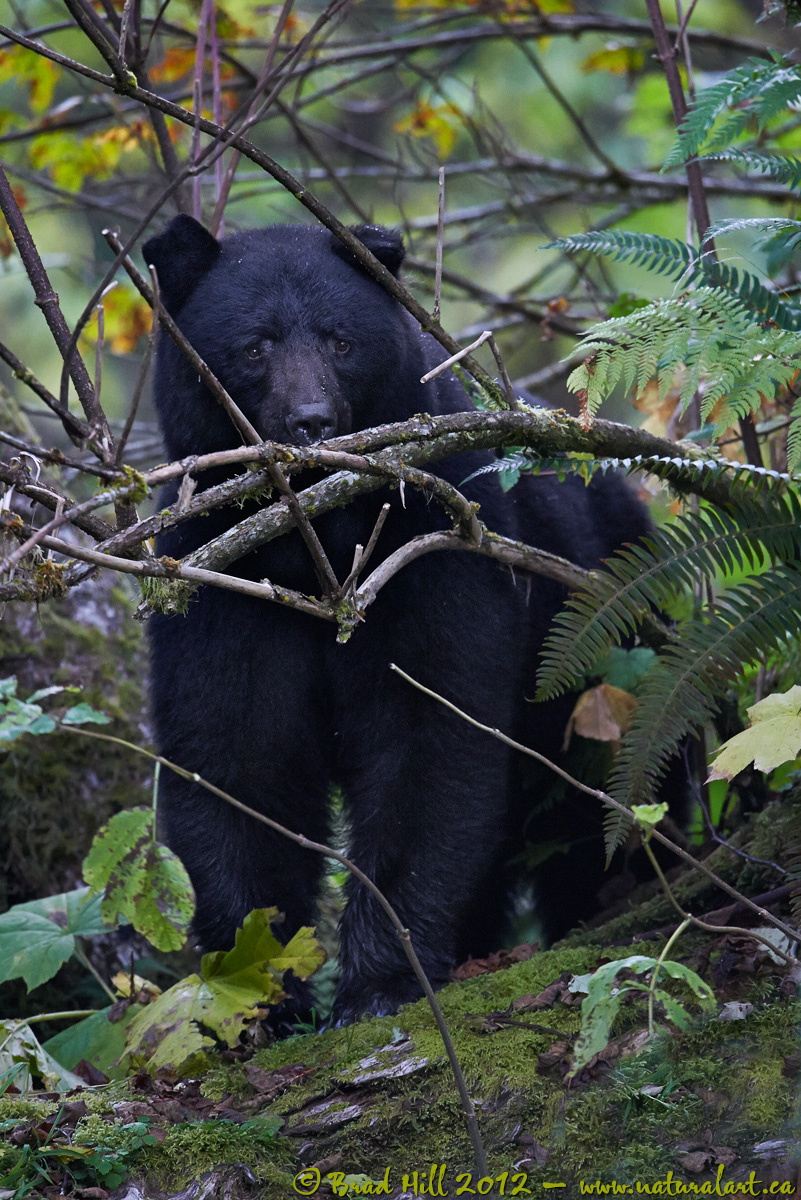
I'm well aware that that this photo will get a very mixed reception. But that has nothing to do with why I called it "Reluctance..."

When I shot this image I did it mostly because pixels are pretty much free. And with a real big dose of "what the heck" attitude. It was long before sunrise and still very dark out (way darker than portrayed in this image). It was one of those "I wonder..." shots. As in "I wonder if my autofocus system will even work in so little light?" And as in "I wonder what this busy scene will look like at ISO 12,800?" To be honest, I didn't think the image would survive my first cull and would likely be binned. And I'm sure the folks who were with me when I shot this were thinking "what the heck is he doing shooting that?" - I get that a lot. So it was a very pleasant surprise when I found it actually did "turn out" and it did convey the feeling of the scene - and the bear - as well as I hoped.
When I was capturing this image I was taken by two things. First, like it or not, this is what many glimpses of bears within the Great Bear Rainforest look like - fern fronds, most-covered logs, tons of yellow/green hues, and a whole lot of branches in front of your subject! So to me the scene really said "Great Bear Rainforest" and I liked it. Second - I really liked the look and "attitude" the bear was giving off - it stood motionless for ages in this spot, just above a salmon stream. Almost like it was arriving at work early and was showing reluctance to begin its day's wet work of fishing for the calories it would need over the coming winter. Maybe it just needed one more cup of coffee before rolling up its sleeves and getting at it! But it just seemed so darned reluctant to commit and hung behind those comforting branches for what seemed like an eternity.
Like virtually all nature photographers I'm aware of the crazy ISO's our cameras will now shoot at. And, from experience I know that how high you can push your ISO up and still get a usable image is quite scene dependent. I know that noise goes up with ISO and that dynamic range and colour depth go down. Some photographers I know simply refuse to shoot at even moderately high ISO's (say above 1600 or so), regardless of the camera they use. But I look at it differently - sometimes a moment is so special - at least to the photographer - that capturing it (regardless of the technical considerations, including using crazy ISO's if necessary) is worthwhile. For me the combination of environmental ambience of this scene plus the feeling conveyed by the bear made this shot worth capturing, despite the lack of light, the busy-ness, and the number of "distractions" in it. Rationalization justifying a "crappy" shot? Maybe. Eye of the beholder stuff? Definitely.
Any take home lesson here? Yep. Guidelines about technical AND creative aspects of nature photography are really just that - guidelines. The minute they morph into rules - be they of the highest ISO you'll shot at or what a composition must (or must not) include - they can completely shackle you. And ensure that before long all your images begin to look alike...
Subject: Male black bear (
Ursus americana kermodei) reluctant to do...anything!
Location: Great Bear Rainforest, BC, Canada
Camera: Nikon D4
Lens: Nikkor 600mm f4 VR lens - Tripod mounted on Gitzo 1348 carbon fiber tripod with Wimberley Head. VR on and in normal mode.
Exposure: 1/640s @ f4; ISO 12,800. -0.67 stop compensation from matrix-metered exposure setting.
Crop: Very minor - this is about 95% of full frame
Additional details about the image (including processing details) available here:
http://www.naturalart.ca/galleries/latest/.
Comments and critiques welcomed - probably best to view the larger version prior to doing so!
Cheers...
Brad

Comments
10 commentsThanks for catching that. D4 - and I fixed the website. But D600 would actually be not far behind...great ISO performance on that camera...
Cheers...
Brad
Sweet One Brad
Ken Archer
I personally don't see a magenta cast, but this same observation was made about my moose image, also shot a high"ish" iso on a D4. If anything, the bear may have a slight cyan coloration. I have often wondered if there is a digital equivalent of reciprocity failure in the film era? I can see that something happens to the dynamic range and colors, but haven't quite characterized exacly what it is....hmmm.