Night Sentinel
by Alex Noriega
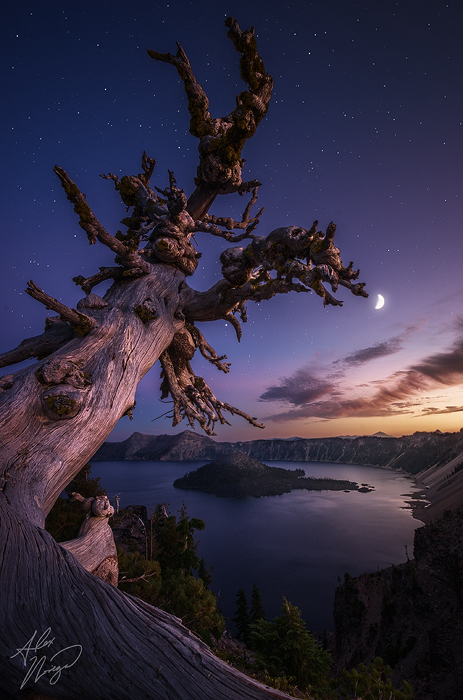
Twilight falls at Oregon's Crater Lake.
Main exposure was taken at 10mm. The moon was enlarged by taking a separate exposure at 24mm for it, and putting that moon directly over the "original". Yes, the position was such that the tree was pointing at it - I just wanted more detail/shape to the moon.
The stars (only the points of white light, not the sky) were overlaid via an exposure from an hour or two later, via the usual method I've been describing.
Credit has to go to Zack Schnepf and Andrew Kumler for the images of this tree that inspired me to check it out. I tried to come up with something different, and I did (which eventually I'll process and post) - but this more traditional comp from here is just the logical conclusion you arrive at if you want to get the curve of the rim, Wizard Island, evening light, and the interesting side of the tree in the composition. It just so happens that branch hangs down so that in one precise position, you can have it frame the distant peak rather than cutting into it.
Nikon D7000, Nikkor 10-24mm

Comments
22 commentsEven putting all that aside, does it matter? In my opinion, no. I don't answer to any photography police. I think it all comes down to taste. I'm not going to throw some super-sized moon from a 500mm exposure over a wide-angle sunset. I believe what I do are faithful artistic interpretations of the scenes. Whether someone wants to call it "photo art" or "photography" doesn't matter to me. (Although all the fundamentals and principles of photography still apply in what I do, so I'm not sure why it wouldn't be the latter.)
The star blend feels to me like it is fighting with the golden tones coming form the rim at sunset. Kind of like fire coming out of ice. Just my opinion.
G
Stunning.
aF
May I add my two cents to the discussion, to provide a different perspective. I see the motivation to apply some techniques to bring an image close to what can be seen with the dynamic range of the eyes and brain of a human. Exposure blending is a good example. And I do this too. Well, if we want it or not, photography to many people means that a "single" moment is shown in the photograph (if we label it as such). If two or more moments are shown in one image, and in particular, if the moments occurred minutes or even hours apart, then we push the envelope of "photography" quite a bit. Ok, that is a matter of definition, but for me the definition needs to account for what commonly is considered photography and what people associate with a photograph - i.e a fleeting moment captured. It is very simple: If the final composition requires to add things up that never existed in parallel, but occured in series, and if we call it a photograph, then it becomes a touchy issue. I am not judging the techical approach of "compositing", but the (perhaps) misinformation of the viewer (client?). Personally, I would be dissapointed to learn "after" having visited a (nature) photographers gallery, that the works are composites. If I know it while viewing, it is a totally different affair. You fully disclosed everything and I can see that the time-compression does not necessarily apply because I see that the scene could look like that in *one* moment, given the dynamic range can resolve it.
I hope this is not considered as "lecture" but as food for thought.
As for the discussions on whether this is a photograph or "photo art", I think the lines are blurred and more importantly, meaningless. This is not a gallery that sets out to be documentary either as a travelogue of places or as a demonstration of the capabilities/limitations of camera gear. This gallery is about demonstrating our artistic vision of natural landscapes as photographers. We each follow our own path on this, and what sadly most people don't realize are 2 things: it's very hard to produce an artistically appealing image with the limitations of the natural world and our ability to capture it with gear. We're not unfettered in the way painters are for example. Second, photographs don't have to be (and are not!) only for documentation purposes. Look how hard Jerry Uelsmann had to fight the artist and photographer community for acceptance. Now he's revered!
Whether they're technically composites or not, they would be the EXACT same images, without white dots in the sky, if I only used a single frame. I could have stretched the moon out from the original exposure instead of taking one with a longer focal length too. One of my motivations for these twilight images, as opposed to traditional night images, is the static stars. If I shoot under low moonlight (the only other time there is good light on the landscape and stars visible, aside from aurora), I need a 10+ minute exposure if I want the landscape to look good at a low ISO. Then I get star trails, which can be nice for a more surreal scene, but I really want to capture the feeling of looking up and seeing static stars in the sky in most instances. So.. if I care at all about quality (shooting at a low ISO), I'm stuck blending exposures - one 30 second one at ISO 1600 for the sky, and one 10 minute one at ISO 200 for the landscape. Is this closer to a "photograph" than the twilight/stars method? Or should I just handhold an ISO 6400 exposure, in the interest of capturing a "fleeting moment"?
I hope I don't seem defensive here, I'm just discussing and giving my opinion on it. To me, the gray area is so wide and could encompass so many situations, that I don't bother limiting myself on the basis of semantics or what some people might think. A majority of my images are still single exposures, not even bracketed, and definitely not composited. Those don't feel any more legitimate or rewarding to have made, for me. As far as my goal of making a living doing what I love, I don't believe "compositing" or blending of exposures will ever hinder me, if I continue to do it in good taste. Look at Marc Adamus, or Michael Fatali - two very different artists that have used compositing to create some of their best images. It hasn't stopped them from being wildly successful in this field. I just use whatever technique will best allow me to make a technically sound, atmospheric image that hopefully elicits the same emotion I felt at the scene. And I'll call it photography when I do it, because I'm taking a camera, mounting it on a tripod, choosing a lens and focal length, determining the appropriate aperture and shutter speed, and using a cable release to open a shutter and expose my light-sensitive material to the scene in front of me and form images.
Kartik, you're right - I'm not a photojournalist! I never purport to present a 100% unaltered image. That's not even getting into the fact that all photography distorts reality, just through the basics, such as: inclusion/exclusion of elements, perspective, field of view, over/under-exposure, and longer shutter speeds. It's all about taste and where you draw the line. Uelsmann, who you mention, drew his line much further out than I do - and *gasp* on film, supposedly the holy grail of purity and legitimacy in photography.
I like shooting at twilight as well and there are often stars visible at that time. Fixing the moon seems fair to me. I have some shots I wish I could do that to.
Let me reiterate that I love the picture and admire your work.
Well done, Alex.
What I have described in my other post is where I have drawn my own line (so far). It is my definition I use when doing photoshop so I can live up to my own ethics or morals. This is not an absolute reference of course, but I was looking for a guideline because I have observed that we (digi) photographers are often not happy how the public perceives the use of photoshop. And I think, some of this scepticism is perfectly valid and our own fault, and it is not due to the lack of insight on photoshop (and dark room) techniques on the viewers side. Because I know what is being done to arrive at the final image and I know that not everything of it is disclosed. I tried contemplating on what people commonly associate with a "photograph" and how it was made . I tried to understand what they would accept in terms of "manipulation" and what they would not approve. I found it boils down to that "one moment in time" thing. However, I did not do any research on that, like doing interviews with potential clients.(I am not a pro anyway). Like you said, many of your clients, when they learn about a technique are impressed, not dissapointed, so I bet I *should* have been doing interviews...
Nick Bristol
Lone Rock, WI
xo
aF