Bashful Bruin
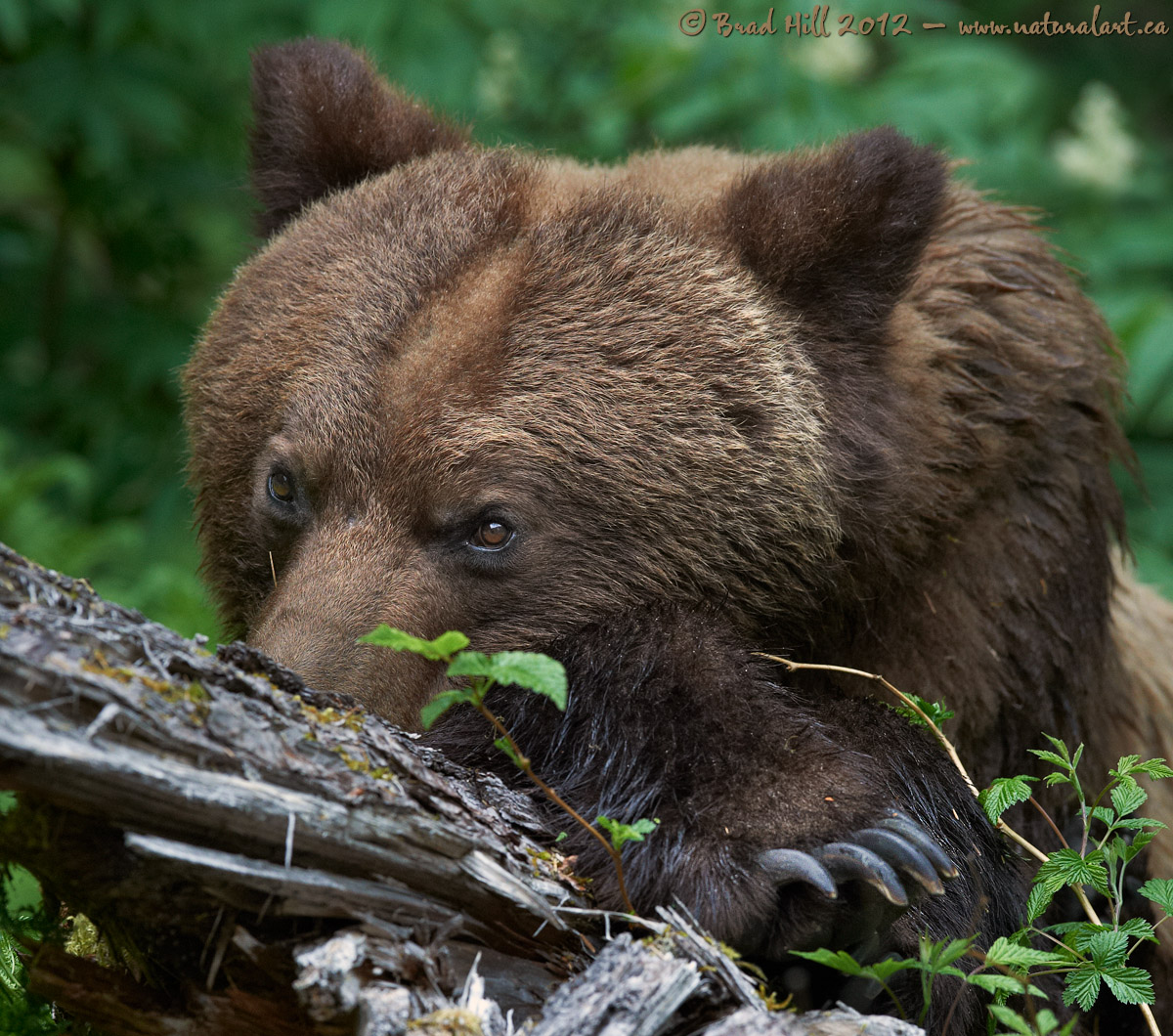
When you're over two meters tall and weigh over 200 kg (that's about 450 lb for those of you south of the border!), it's kinda hard to hide behind a few small leaves. But that didn't stop this bear from trying just that!
This is one of those images that drives me a bit crazy. I go from loving the shot to being frustrated by it - every single time I look at it. The issue in my mind: do those out-of-focus leaves just below the eye constitute a major distraction or do they actually add to the image (given that the bear appears to be trying - completely in vain - to hide behind them)? I love the bear's left eye and how the bear is draping its head over its paws (and those claws work well for me too).
I have no doubt that I will be able to put this shot to good use. And it's likely it will generate at least some revenue. So it does have value.
This image points out at least one more thing worth considering - with some images there is a vast difference between how the public perceives an image vs. how other photographers perceive it. Most members of the public simply react to images - the images have an impact on them or they don't. They don't know why - and they don't care. It works or it doesn't. And, I suspect that this image would be received well by most non-photographers - the pose, and especially that eye, are powerful enough to illicit a reaction.
Many photographers, on the other hand, often like to dissect - or break down an image - into its "building blocks". This is very understandable - they're simply trying to understand why some images work and others don't. In doing so we hope to figure out what elements individually contribute to the success (or lack thereof) of a specific image. So we end up with a set of "rules" to follow when building an image - things like the "rule of thirds", using "leading lines", avoid distracting elements, etc. This dissection of an image has value. But...there is a danger to this: you can end up seeing all the individual trees but never even consider what the forest looked like! in other words, in an effort to understand what makes an image work, you can overlook the fact that it simply DOES work (and that not all images need to conform to a few simple rules of image construction).
Just some food for thought...
Subject: Adult female Grizzly (
Urus arctos) facing a decision
Location: Khutzeymateen Inlet, Great Bear Rainforest, BC, Canada
Camera: Nikon D4
Lens: Nikkor 400mm f2.8 VRII lens - hand-held. VR on and in "Normal" mode.
Exposure: 1/400s @ f7.1; ISO 3600. -0.67 stop compensation from matrix-metered exposure setting.
Crop: This is about 85% of the full-framed image.
Additional details about the image (including processing details) available here:
http://www.naturalart.ca/galleries/latest/detail_2.html.
Comments and critiques welcomed - definitely best to view the larger version prior to doing so!
Cheers...thanks for looking...
Brad

Comments
12 commentsOne day I will join you for a tour.
Jamie
My thoughts? This one DOES work. And it works well. At least for me...
It succeeds in that crucial aspect that is lacking in so much of the photography we see online every day - it tells a story. The picture is worth the proverbial 1000 words (okay, maybe fewer words, but the metaphor is valid
Thanks to the feedback so far on this image. A few specific responses:
1. Butch: You say (mostly in jest I assume): "I want to know is who give the bear a buzz cut on his fore head"
Interestingly, this "male-pattern baldness" is common in the bears in this region. And, more often than not, it's most visible and/or pronounced in some of the older males. But, as this image shows, some of the females exhibit the characteristic as well. I think it's just a local genetic thing...
2. David: You say: "Nature photography has become subject to too many rules and I think that it distracts and takes away from the pure pleasure of viewing pieces of art..."
While I tend to agree with you, if there's a place where images should be nit-picked, it's here in a critiquing gallery! I have heard from some newer members who have been more than a little intimidated and have wondered why images of theirs that have gone over well elsewhere get "beaten up" in here. My commentary was designed to answer this question and to bring up the "can't see the forest for the trees" concept that can show it's head in a critiquing environment - as mentioned above (and that you're alluding to). I think one of the greatest dangers of forums like this is the tendency towards "group think" in terms of those "rules" of photography - which is a huge impediment to creativity. Confident, mature/advanced photographers can (and largely do) ignore that tendency, but it's much tougher for developing photographers to ignore or even recognize the onset of "group think".
Cheers...
Brad
Very Nice Work Brad!!!
Ken Archer
Well done