Shake it Up!
Probably the best way to relegate an image to obscurity is to post it on the Thursday before a long weekend (officially in Canada, and I suspect more than a few will turn it into one below the border)...but what the heck...
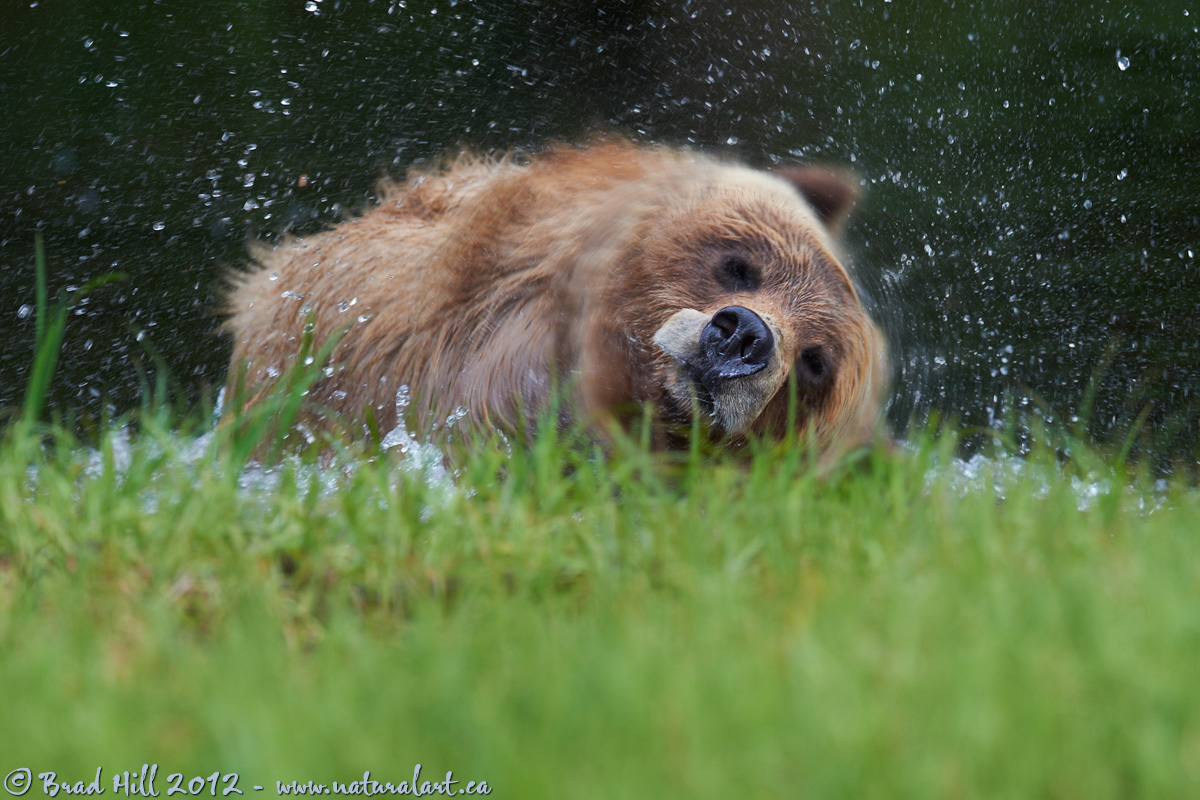
One of the most predictable things in the animal world is that when a swimming bear gets to land, it wildly shakes its whole body! So, if you know this and happened to be in a position in FRONT of the bear, you have a good chance at capturing a reasonably interesting shot - assuming you know the shutter speed to select. Which begs at least two questions. First, what shutter speed do you need to freeze action? And, what shutter speed do you need to pull off the tricky old "freeze-blur" combination (as shown here)?
In answering both these questions I could point out a million little things that could affect the answers - things like how big the subject is in the frame, how fast the subject is moving, what resolution the final image will be displayed at, etc. But at the end of day really only one thing has to be considered: how many pixels (or, a little more correctly, photosites) is the moving object going to cross on your image sensor per unit time? Cross MORE pixels per unit time and you need a faster shutter speed to freeze the action. Cross fewer and you can get by with a slower shutter speed (and still freeze the action). So, a distant subject that occupies a tiny portion of your viewfinder can be frozen at a much slower shutter speed than can the same object that is moving at the same speed but is much closer.Why? Because when closer it's crossing more pixels per unit time. There are lots of consequences of this - to freeze the action using a higher resolution camera (like a D800) that has "tiny" photosites on its sensor requires a much higher shutter speed than doing the same on a lower resolution camera (such as a D3). So...given the number of different cameras (with different resolutions) in use and how many different shooting situations exist (particularly in reference to how close the subject is), it's virtually impossible to give an absolute rule of thumb. The best thing I can suggest is keep the "how many pixels crossed per unit time?" concept in mind and get out and shoot some test shots with YOUR camera.
Subject: Adult Grizzly (
Urus arctos) shaking off water
Location: Khutzeymateen Inlet, Great Bear Rainforest, BC, Canada
Camera: Nikon D4
Lens: Nikkor 400mm f2.8 VRII lens - hand-held from floating zodiac. VR on and in "Normal" mode.
Exposure: 1/400s @ f5; ISO 320. -0.33 stop compensation from matrix-metered exposure setting.
Crop: This is about 85% of the full-framed image
Additional details about the image (including processing details) available here
http://www.naturalart.ca/galleries/latest/detail_2.html.
Comments and critiques welcomed - probably best to view the larger version prior to doing so!
Cheers...thanks for looking...
Brad

Comments
5 commentsYour write-up, however, is fantastic. The way you have analyzed the whole thing - camera, the number of pixels available, the size of the subject, the distance from the camera, the subject's speed of movement.......amazing! Do keep writing, please!
Thanks for the honest feedback - always appreciated! And, if you're into reading, you can definitely find a LOT more on my website (but you probably already know this!).
Cheers...
Brad
BTW if you are still doing a talk the weekend a friend of mine is hoping to go, a young photographer who is doing his little bit for the local bears, I have asked him to try and nab you, well for a few minutes only.
cheers
Steve
Yep, still doing the talk in Vancouver on Saturday July 7. All the details available right here:
http://beatymuseumfeastlecture.eventbrite.com/
And no plans to quit writing (or posting images!!) - what the heck started that rumour?? I'm getting lots of email about it! Will be traveling over the next while, so won't post much over the next week to 10 days, but lots more up my sleeve!
Cheers...
Brad
Steve