Baboon-Captive
by Steve Zimic
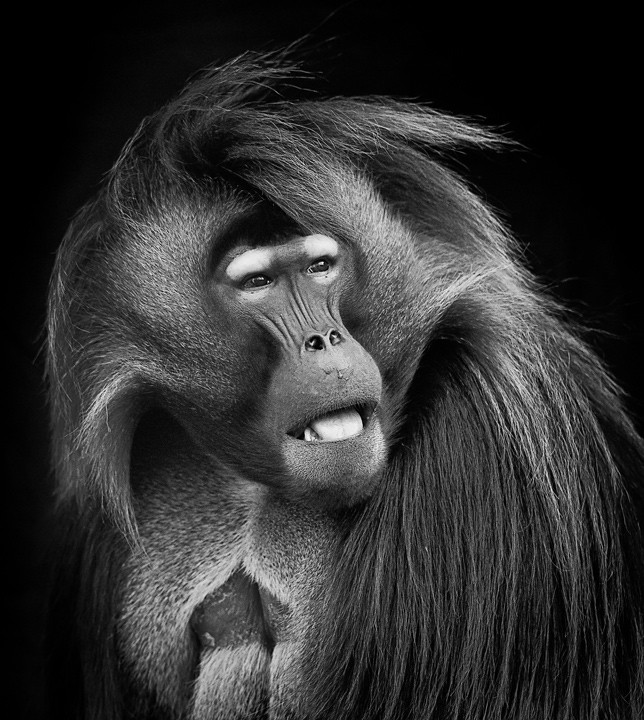
I wish I could say I made this image in the wild, but alas it was shot at the Bronx Zoo. This big old toothless guy often sits in an alcove that makes for that nice black background. You have to shoot through plexiglass which in this case had the sun hitting it. The original image was so washed out I almost trashed it. What I was able to pull out of this image using Adobe camera raw was simply amazing. I used my Nikon D700 with the 300mm f4 shot at ISO 5600, f6.3 and 1/320sec. The BW conversion was done using Nik Silver efex pro. Thanks for you comments.

Comments
21 commentsTake a photo of a baboon in the Bronx Zoo. The details around the face area is stunning.
Oscar
While I'm not normally a big fan of zoo/captive shots, I really like this. Great composition (and expression) and excellent post-processing (and I love the B&W conversion). Thumbs up on this one - big time!
Cheers...thanks a ton for sharing this beautiful portrait!
Brad
Wonderful pose and treatment here. Exceptional detail and proof that "even" zoo shots can be compelling enough for WP's.
Sandy
Whilst I think that the processing of this image is quite remarkable.
I have the following to say this is not a Baboon, it is a Gelada!
They look a lot better in the wild, but the mountains of Ethiopia are a long way to go
The gelada (Theropithecus gelada, Amharic: ጭላዳ, translit. č̣əlada), sometimes called the bleeding-heart monkey or the gelada baboon, is a species of Old World monkey found only in the Ethiopian Highlands, with large populations in the Semien Mountains. Geladas are actually not baboons (baboons are all taxonomic members of the genus Papio) but members of their own genus Theropithecus. Theropithecus is derived from the Greek root words for "beast-ape".[3][4] Like its close relatives the baboons (genus Papio), it is largely terrestrial, spending much of its time foraging in grasslands.