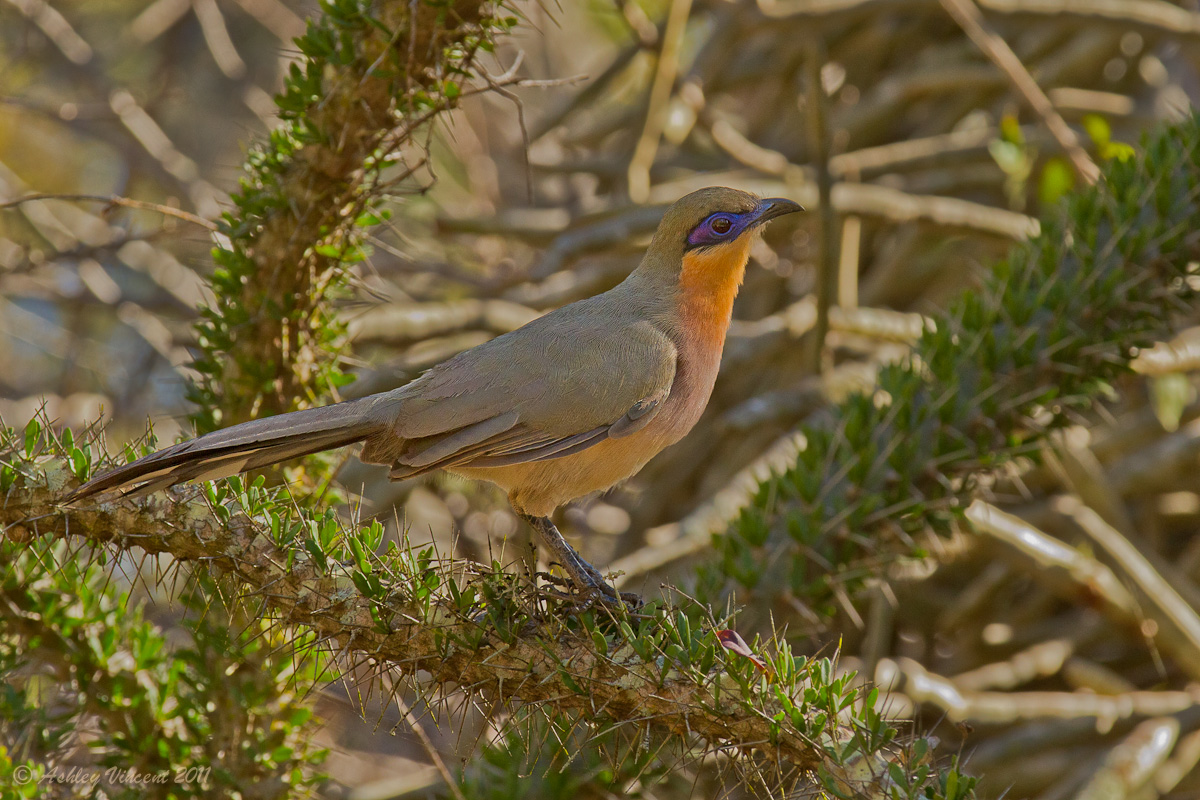
Running Coua
by Ashley Vincent
Canon EOS 7D, EF 70-200mm f/2.8L IS USM MK II + 1.4x Extender MK III @ 265mm, Aperture Priority @ f/8 (1/200 sec), -2/3 EV, ISO 400, Handheld, JPEG from RAW, About 60% of Full Frame
As I only had four full days of photography while in Madagascar, and my primary goal was in capturing as many good images of my beloved Lemurs as possible, naturally my time spent looking for birds was somewhat limited. All the same, I took opportunities when they presented themselves and set a few hours aside on my last morning, so I do have a number to show you.
This first one is of a species I believe is endemic to Madagascar, Couas, and as it's name subjects, the Running Coua is most often found scurrying along the forest floor while looking for bugs n insects to eat.
Critique and comments always welcome.

Comments
9 commentsAs with many of your other bird posts this image lacks contrast. How much tonal adjustments do you make to compensate for sub-optimal lighting conditions?
May
Ray
Richard: As it happens, the natural colouration of the crown, neck, back, upper wings, and tail of the Running Coua is indeed very much subdued, probably as it spends so much of it's time on the ground - which is mostly the same colour - looking for bugs n stuff to eat, and from above it's less likely to be seen by raptors.
That said, when looking at it on my monitor back home, I too thought perhaps I could bring more out of it in post-processing. Thing is, that increasing contrast on the whole bird immediately gave the orange parts of the plumage as well as the blue facial areas a completely unnatural look, and when attempting to work simply on the duller beige areas it all too quickly changed the appearance of it's natural colour. Bottom line, this is the bird's colouration.
In fact, looking at the field guide I brought back from Africa with me (Birds of the Indian Ocean Islands) and checking this against the picture they have of a Running Coua, mine is indeed a little more saturated, which is likely because I added at least a touch of Vibrance.
While of course I don't expect everyone to see things the way I do, I am quite surprised you feel that "many" of my bird posts lack contrast; if anything I'd think people might suggest that a good number of them are more on the bright side, simple reason being the birds that attract me the most, and the ones I love to photograph the most, are species with wonderfully vivid colours, and generally speaking I like to process such images in a way that brings the very most our of the colours while holding myself back from going too far!
This being the case, I would be very interested if you could point out specific bird images of mine that you feel are lacking in contrast, as perhaps there is something I'm overlooking. Please feel free to email me about this if you'd prefer. Whatever the case, thanks for offering you candid thoughts and opinion.
But what I've noticed with many of your posts, and especially with this one, is that the overall tone and contrast looks unnatural. They often remind me of the artificial look of High Dynamic Range processing where the shadows have been opened up so much that what should appear dark is pushed into the midtone region at the expense of the actual midtones.
Looking at this image with a threshold layer added shows that the tones are bunched up in the middle (32-187 range) with long tails extending on both the dark and light sides. Tossing away those long tails by adding a levels adjustment layer with the black slider at 32 and the white slider at 187 fixes the midtone contrast problem. But it also makes the colors of the bird very saturated (based on looking at lots of shots of this species with a google image search). Adding a saturation adjustment layer and pulling saturation down to -35 helps.
Looking deeper into the exif and processing data for this image reveals what I believe to be the underlying issue. The timestamp on the image shows it was taken at 7:49 am in what looks to be bright light. In raw conversion you subtracted .35 stops of exposure to darken the image a bit, added 27 points of fill light, and also applied 100 points of Highlight Recovery. The +27 points of Vibrance helps explain the high saturation.
Shooting in soft light closer to sunrise is a better way to deal with the dynamic range of an image than trying to compress the range in conversion and post processing.
I don't have the time or the desire to dig this deep into some of your other avian posts but I suspect I'd see similar dynamic range compression issues that make the tones appear unnatural to my eye.
Well done.