Yoga for Birds 101
by Ashley Vincent
Canon EOS 7D, EF 500mm f4L IS USM, Aperture Priority @ f/8 (1/2500 sec), -2/3 EV, ISO 400, Tripod, JPEG from RAW, Pretty Much Full Frame; Cropped a Sliver from LH Side as Well as Upper & Lower Edges
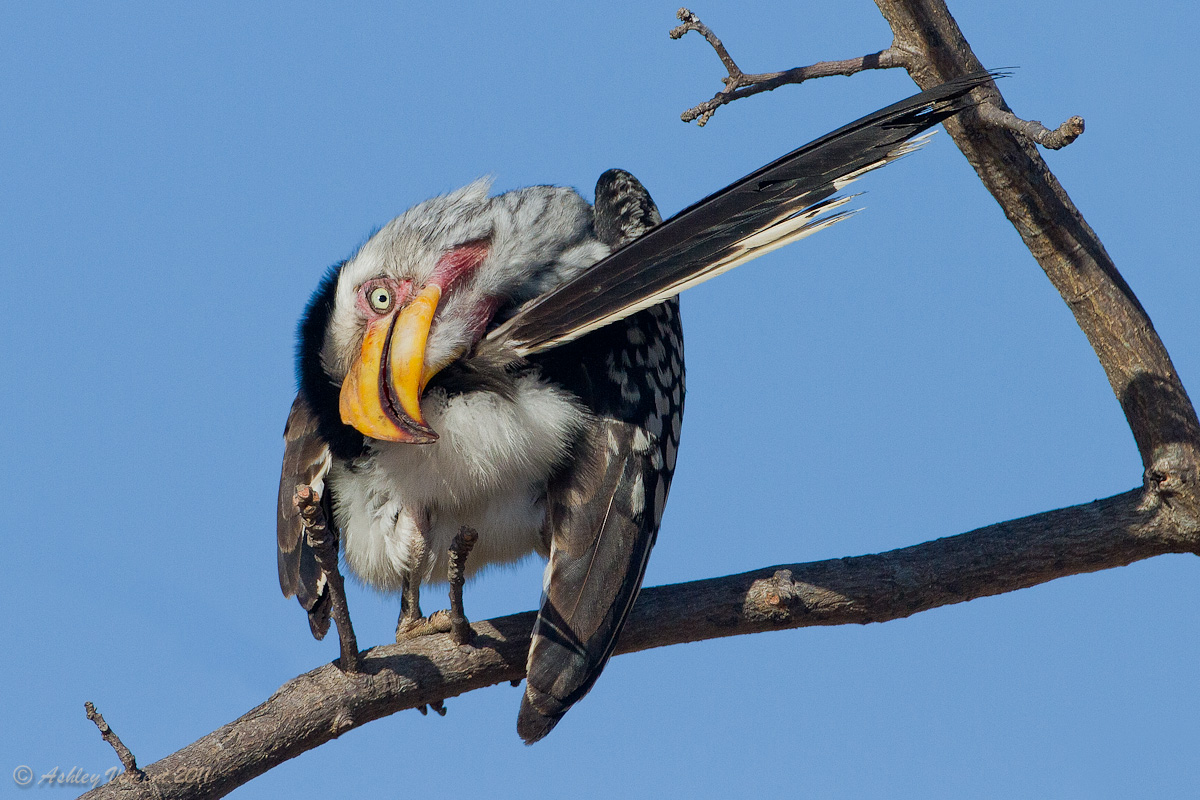
While in truth this Southern Yellow-Billed Hornbill was for the most part actually preening, there were times like these were it looked like it was stretching to warm up it's muscles for the activities of the day ahead. Of course I could be wrong, but the impression I came away with was that this guy knew a thing or two about the discipline of Yoga!
Critique and comments always welcome.

Comments
12 commentsThanks for responding to my other comment, I really appreciate the input. Cheers! Mark
Great behavior shot.
May
I had no idea what to expect when looking at the thumb nail but this is really cool. Wish I had moves like that. Love your title. The eye contact and the beak are very sharp. This one is priceless.
Ray
Peter: Never having heard of the "uropygial gland" before, I had to look it up, and real pleased I did: The information I found on gave me one of those "Ah Ha!" moments, as it explains the reason for this behavior that I've seen with more than a few species of different birds too. Many thanks for helping to enlighten me further :^)
I find the info so interesting that I'll go out on a limb and send you all a copy of what I read, curtesy of Wikipedia:
“The uropygial gland, informally known as the preen gland, is a gland found in the large majority of birds that secretes an oil (preen oil) that birds use for preening. The chief compounds of preen oil are diester waxes called uropygiols.
The gland is found near the base of the tail and is shaped into two symmetric parts. The oil of each part of the gland is secreted through the surface of the skin through a grease nipple-like nub. A bird will typically transfer this oil to its feathers by rubbing its head against the oil and then around the rest of the body. Tailward areas are usually preened utilizing the beak. Not all birds have a uropygial gland. Exceptions include the emu, kiwi, ostrich, and bustard. These typically find other means to stay clean and dry, such as taking a dust bath.”
Hope that this was interesting also to those of you who weren't aware of this, and those that were, hope you weren't bothered too much by this email ;^)