Flying Adder?
by Charlie Baugh
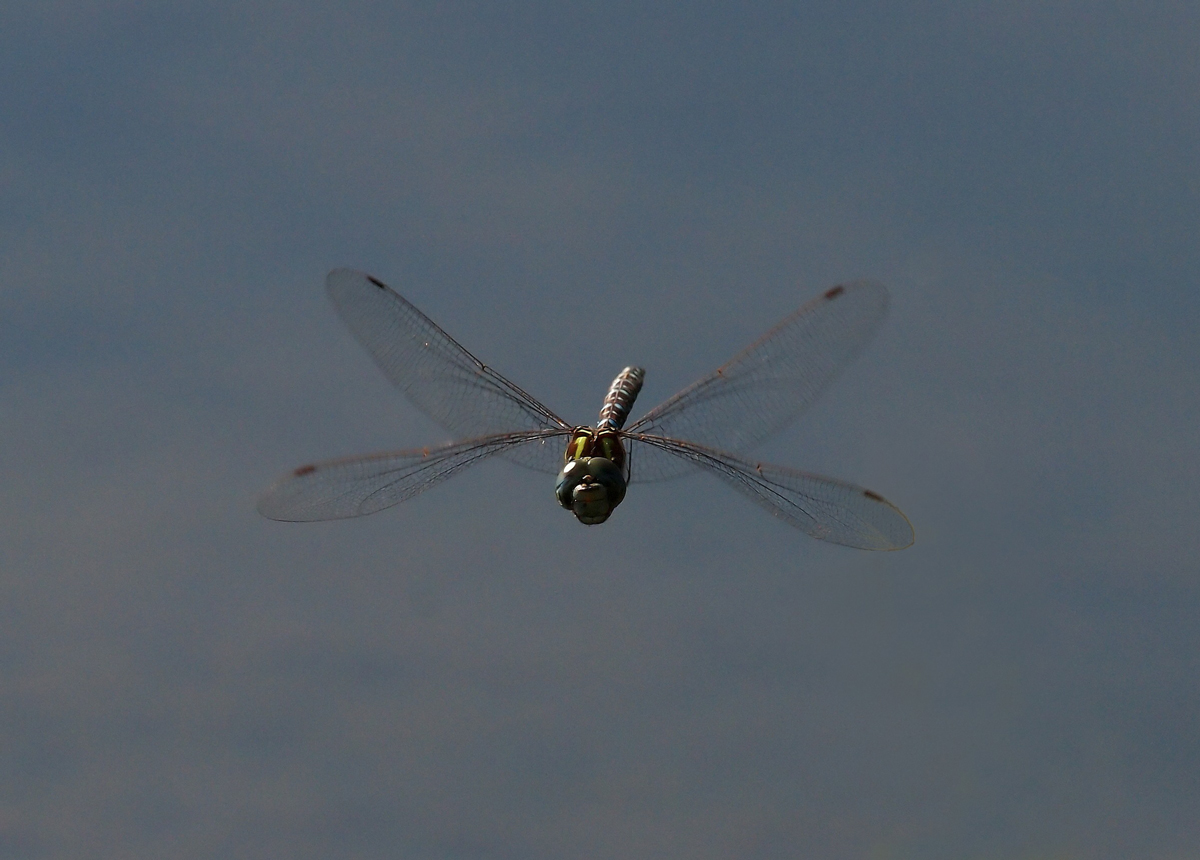
Possibly a Western Flying Adder, Cordulegaster dorsalis. I caught this DF depositing eggs in the pond but couldn't catch it touching the water. Stopping those wings will require more than 1/1600 sec. SS.
Please, if you know the definite ID I'd like to know. I'm very unsure of this.
E-5, 50-200mm =1.4 TC
1/1600 sec @ F8, -0.3 EV
flash off
spot metering
ISO 800
manual focus
one of 5 frames sequestial shooting.
Large view provided
Comments and critique appreciated.

Comments
12 commentsDetails looks great, hard to catch em' head-on like this
Charlie
About the ID -- I hope this helps. I am not familiar with western species, but from what I know of spiketails (family Cordulegastridae) this does not look like one (algthough it's not easy to tell from one shot at this angle). Cordulegaster (and all members of this family) do not have the "football helmet" compound eyes typical of darners and other dragonflies. Their eyes are thinner, narrowing down almost to a point where they meet at the top of the head. This is the main ID feature of the family. Also, your story sounds like this one was ovipositing in the water. Cordulegaster (at least the eastern species, but probably others) has a unique way of laying eggs: They hover vertically, in a head-up position, and thrust their tails into shoreline mud -- rapidly up and down, kind of looking like a sewing machine.
Offhand, I think I would start looking for matches in the family Aeschnidae (darners) if I saw this in the east, but again, I am not familiar with your western critters, so it might be something else. Spiketails are pretty distinctive, though -- and from this angle it just doesn't look like one. I could be wrong, so look at your other shots and the behavior you saw, to see if it matches the family discription above. All US spiketails are in the genus Cordulegaster. Good luck.
I use a collection of books I collected over they years as a student and later as a researcher. Many of them are rather specific to a single order or family of insects, with some being limited geographically, too. For instance, my main Odonata reference is a guide to the Odonata of Massachusetts. (Close enough to NY to cover what I find. Maybe there is a similar resource for western Odonata?) My most comprehensive and very used book for keying out unfamiliar insects to family is sort of the bible of Entomology, Borror and DeLong's Introduction to the Study of Insects. It's kind of technical, with basic ID relying on a knowledge of insect morphology (body parts), but there is a chapter on that if you really want to get into it. It's also an expensive book, with used copies going for about $75, and new ones twice that price.
While looking up current prices of Borror and DeLong, I noticed that there is a much less expensive book co-authored by Borror, A Field Guide to Insects: America North of Mexico [Paperback] which is one of the Peterson Field Guides. Sounds interesting, but I have not seen it, so I can't comment further. Read the reviews and see if it sounds like what you are looking for.
IMHO, unless you are dealing with a few hundred "popular" insects, you can be led astray easily in ID unless you first figure out what ORDER the insect is in, and second, find out what FAMILY it is in. (Your experience with this dragonfly illustrates that it's easy to be led astray basing ID on overall appearance instead of key features that separate the families.) With that in mind, I did the following search.
WEB SITES: I just spent a fun half-hour looking at what's there.
-- First, I Googled "odonata family key" and the first site I found was Key to CALIFORNIA DRAGONFLIES & DAMSELFLIES (Odonata) at http://sonic.net/~bigsnest/Pond/dragons/CA_key.html. Looks like just what western Odonata entusiast need! Give it a try.
-- Next, for more basic info for ALL insects, I googled "insect order key" because knowing what order the insect is in is the most important part of insect ID. Here are a couple of sites I found after a very shor search that look like they may be more useful than the big, technical books:
http://insects.tamu.edu/fieldguide/orders.htm -- Very good basic info -- read the introductory parts! -- good for basic understanding of the scientific classification of all plants and animals.
http://www.sci.sdsu.edu/classes/bio462/easykey.html -- Easy Key to the Insect Orders. This looks like a basic, but very useful resource with good examples and drawings.
Thanks again.
Charlie