Celebrating the Wild Life
I've just returned from my
"Orcas, Humpbacks, and More..." Photo Tour...we found tons of Orcas but the humpbacks, dolphins, sea otters, and sea lions stole the show! Lots of images coming over the next few weeks!
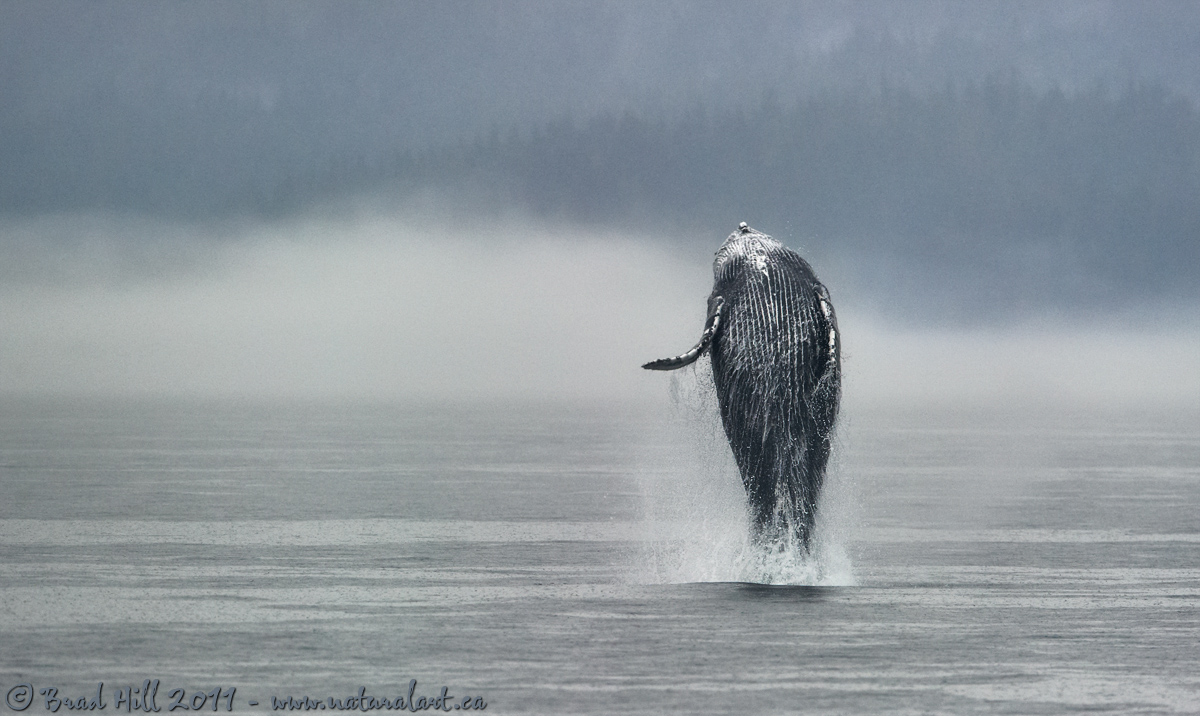
Some things seen in nature almost don't add up. Seeing a massive creature like a humpback whale exit the ocean in a short flight that literally defines the phrase "grace in motion" is DEFINITELY one of those things! How the heck can a 35 ton "blob" acquire the coordination and agility of a ballerina?? Simply mind-boggling!
And...why on earth DO whales breach in the first place? Some argue that breaching - and the resounding and almost deafening "crack" they produce when they land - serves a communication function. The "target" of the communication may be other whales (in this case other humpbacks) or, some have suggested, it may even be directed at boats (as a warning for them to stay back). Others have observed that following a breach a lot of "debris" (including dead skin and parasites like sea lice and barnacles) are found in the ocean and have argued that breaching serves to scour the skin. But ultimately no one is sure of the exact reason behind breaching. So no one can really argue against the idea that this whale wasn't just doing it to celebrate the wild life it leads! While I watched this whale it was REALLY hard to stifle the thought that this whale was breaching simply for the sheer joy of it.
I shot this image on a rainy, foggy August afternoon from the deck of a sailboat. In many ways this was - at least technically - one of the most challenging shots I've ever had to capture. Humpbacks breach quite unpredictably - and figuring out where they're going to surface is pure guess-work. We chose to sit a long ways back from this whale (which was repeatedly breaching) to avoid disturbing it. This meant that the only way to capture it was to use a long telephoto (I used a 600mm lens for this shot). Which produced challenge #1 - getting the whale within the narrow field of view (and thus the viewfinder and image frame) in the split second when the whale surfaced. The solution to that problem? I had my 600mm lens mounted on a firm tripod and Wimberley head - so the lens moved easily and smoothly. I placed my left arm along the entire length of the top surface of the lens so it was fully outstretched (and with fingers extended to the end of the lens). That left me with a long pointing arm. And, you guessed it, I used that arm as a "sight" - rather than looking through my viewfinder I simply swung my arm at the target (and, of course, the lens followed) and began firing. With a little practice and "calibration" I quickly was able to judge exactly when subjects would be in my viewfinder without looking through it. Problem #1 solved!
And then there was problem #2 - focusing. Before the whale surfaced this was a scene that had virtually ZERO contrast in it. Basically, there was NOTHING to focus on in the distance range of the whale! Expecting my AF system to focus on an off-centre whale in the instant it breached was asking too much. Before the whale surfaced, the AF on any lens I tried (from wide angle through to my 600) simply racked in and out and found nothing to "grab" on to. So, I manually focused on the faint ripples on the surface at a distance where I HOPED the whale would surface. Then, each time it breached, I swung my arm around and fired. Amazingly, I ended up with a high hit rate for focus, but that hit rate was high only when the whale was in the centre of the frame. This shot is one of the only frames with an off-centre whale that came out sharp (this is close to the full frame shot and I didn't move the whale off-centre via cropping). Lady luck was smiling on me when I captured this!
Subject: Humpback Whale (
Megaptera novaeagnliae) jumping for joy!
Location: Johnston's Strait region of north Vancouver Island, BC, Canada
Camera: Nikon D3s
Lens: Nikkor 600mm f4 VRII lens supported on carbon fibre Gitzo 1348 tripod with Wimberley head
Exposure: 1/2000s @ f5; ISO 1600. +0.67 stop compensation from matrix-metered exposure setting.
Crop: Very minor - this is about 95% of the full-frame image
Tons more info about this shot (including quite a conservation rant!) can be found on my website - right here:
http://www.naturalart.ca/galleries/latest/.
Comments and critiques welcomed - probably best to view the larger version prior to doing so!
Cheers...thanks for looking...
Brad

Comments
20 commentsMax
Gary.
AMAZING
Very well captured !
Jagdeep Rajput
Nothing quite nails it, but you sure did!
Wonderful mood, gorgeous overall palette, outstanding detail. The texture of the whales underside and water falling from its body and fins is spellbinding.
Once again your decisions in the field and in processing were bang-on. Love the overall comp as well.
THIS is a top-shelf image, and joins several bears in my all-time favourites of yours.
.... wordless!!!!
Chris