Navajo Arc + repost
by Doug Koepsel
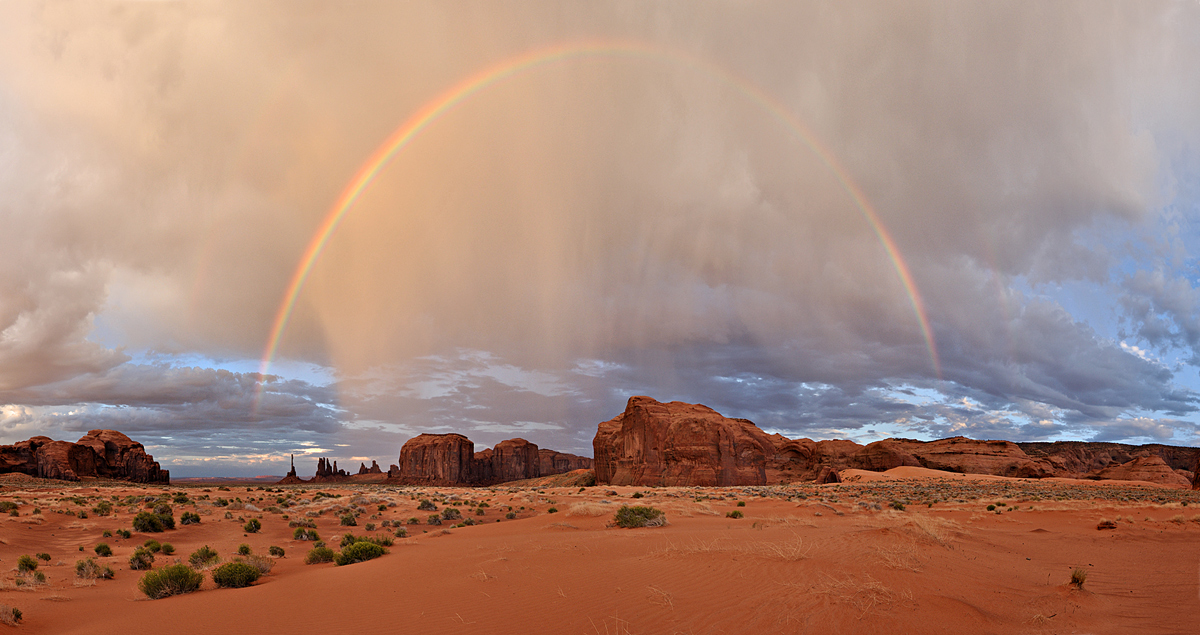
Last week, I was able to join a group of photographers for a day at Monument Valley. After photographing a rug weaver in her hogan, and a sheep run at Ear of the Wind, the day concluded with a rainbow over the valley. I have posted other images in the RMNP forum.
This pano is a stitch of 8 vertical images using PSE9. Nikon D90, Nikon 16-35 @ 19mm, f/8, ISO 200.

Comments
20 commentsGary.
I'm a photoshop nut so I might have a quick and simple fix for this if you are interested. All you need to do is duplicate the layer, then do a transform. Compress your rainbow to a more realistic shape, ignoring what it does to the rest of the image. Take the layer with the fixed rainbow and drop the opacity a little bit so you can see the image with the undistorted rocks. Line the two layers up to something that looks good to you, then do a layer mask on the rainbow layer. Mask out the bottom of the rainbow layer until you see the rocks from the main layer. Make sure you remove the opacity from the rainbow layer before flattening. Piece of cake. ;] You'll lose some height on the image, but that's trivial for a pano shot like this.
Again...awesome photo.
Thanks for the technique. Here is a low-rez, quick attempt using the 1200pixel image to see how it works. Danke.
This is spectacular event you captured, Doug!
As always, I believe the skies (only) could use a bump in contrast (or Image Polish) to make that rainbow 'pop'.
That's really a minor nit, though. Consider yourself blessed my friend, and give it another friendly stretch as Nic suggested.
What a glorious moment on nature! Thanks to Nicolaus for the great tip - your repost looks much better distortion-wise, although I think you could go just a little further. And this image is certainly worth the effort - what a special moment you've captured for all eternity.
Lon
Tony, if I can go into physics teacher lecture mode (my day job; forgive me) it's not possible to view a rainbow obliquely. Each rainbow is unique to a given viewpoint, constructed out the interaction between the sun's rays and raindrops. The rays refract and reflect to form a cone; each person or camera sees part of a circle traced out by that cone.