Waterworld Flower
by Wayne Jones
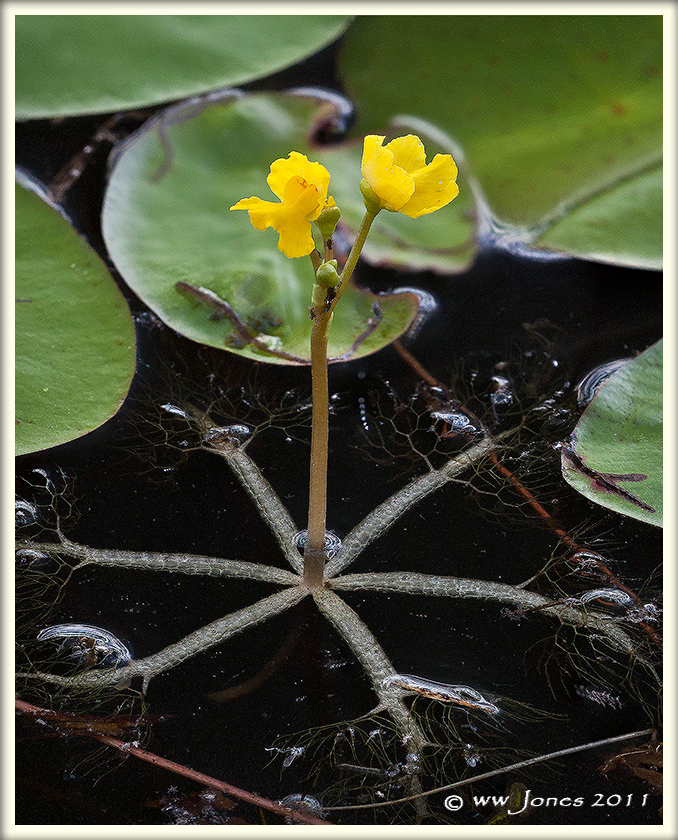
A. The Plant: How does a drifting, underwater plant with no leaves or roots keep its flowers above water?
The Small Floating Bladderwort, Utricularia radiata is a threatened species in NY and endangered in some other states. (It looks a lot like the Inflated Bladderwort U. inflata but is much smaller. Oddly, the larger plant is considered an invasive weed in some places.) Since this is a drifting, suspended underwater plant that has neither roots nor leaves, it produces a radiating set of spoke-like floats to support a stalk that keeps its flowers above water where they can be pollinated.
Like other bladderworts, its underwater filaments have bladders with tiny hairs that trigger a very sudden inflation of the bladder, sucking in and trapping the small aquatic creatures that disturbed it. The trapped critters are then digested by the plant, causing the bladder to shrink, preparing it to capture the next unlucky victim.
B. The Photograph: How do you capture an in-focus image of a small floating and drifting plant in water too deep for a tripod, when the parts of the plant are farther apart than the depth of field of you lens?
I shot this from my canoe, drifting along with the plants, using my stacking-on-the-fly technique. Steadying the camera on the edge of the canoe, I shoot in bursts as the subject and/or camera drift, either increasing or decreasing the lens-to-subject distance. If the motion goes mostly forward or backward instead of sideways, I can get a pretty good set of images for stacking. A similar burst technique can also be used to capture stackable sequences of images of gently-moving subjects such as flowers or insects resting on plants when there is a slight breeze, using a tripod.
Canon 50D
Sigma 150 mm. Macro; Circ. Polarizer
1/60 sec. @ f/11; ISO 400
Hand-held from canoe, shooting in bursts
7 images stacked in CS5
Double-processed in ACR to control brightness of flower.

Comments
12 commentspat
Charlie
Thanks for the bg info, I learnt something today.
Nathan