Stellar Sunshine
by Christian Klepp
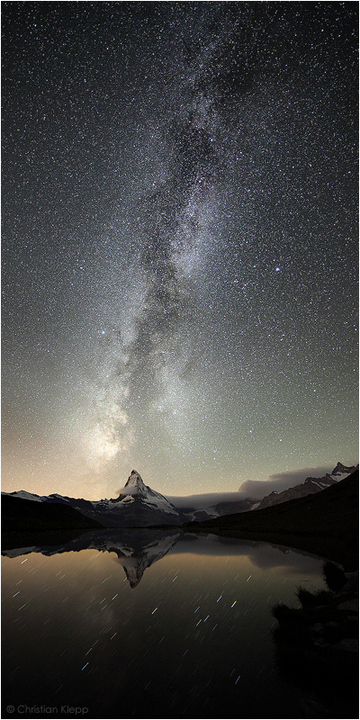
In August around 3 am the Milky Way rises above the 14692 ft (4478 m) high Matterhorn in the Swiss Alps. After moonset or at new moon millions of stars belonging to our galaxy light up the sky. Realizing pointy stars during the 4 minutes exposure time requires star tracking with the camera to compensate for earth rotation. This causes also faint stars to appear on the image so that the number of stars visible largely increases. However, the reflection of the stars in the lake remain as trails as the star tracking is mirrored and hence tracks in the wrong direction. Hence this effect documents the dynamics of the earth rotation. Under the vast firmament of the Milky Way the star constellations of Sagittarius and Scorpius are setting below the horizon to the left and right of Matterhorn. The twofold Milky Way intersected by dark clouds of interstellar dust shows the constellations of Scutum and the Ophiuchus. Just above three bright stars are visible that belong to the so called summer triangle. These stars are Atair of Aquila, Wega in Lyra and Deneb in Cygnus. The constellations atop the image belong to Cepheus and the Cassiopeia.
August 2011
Canon 5D MkII, Rokinon 14 mm, f/2.8, static and dynamic exposure of 4 min, ISO 1600, tripod, AstroTrac TT320 digital astronomical mount

Comments
19 commentsof course you are right - such photography only works as a composit of two images, as is stated in the technical description: static and dynamic exposure of 4 min. The static / dynamic border is the mountain horizon line, both images were done with no temporal delay between them.
Cheers
Christian.
The sky looks strange and void of color. Someway along the processing you lost the color in both stars and the Milky Way.
The duality between the tracked stars and the untracked reflection is a little odd to my eyes.
Chris
@Floris van Breugel: The only possibility getting point stars in the lake I can think of would be a very short exposure time using very high ASA settings, but this would cause high noise. If you come up with ideas how to I would be very thankful.
However, I like this effect as it nicely demonstrates the unavoidable earth rotation.
Thanks for all your comments on this image!
Cheers,
Christian.
Nick Bristol
Lone Rock, WI
EDIT: or simply shoot the reflection at a lower ISO--there's not much happening there anyways and what is there is mostly black.