Trying Something New
by Chris O'Donoghue
Up to now, all of my insect and close-up photos have been taken using a tripod and natural light. I've only used flash and reflectors for fill. Finally yesterday I rigged up a hand-held setup using flash as the primary light source. I used my 180mm macro with my SB-600 flash on a bracket and a Lumiquest softbox on the flash. I manually set my focus to minimum focusing distance, adjusted the bracket to aim the flash at the focus point from over the front of the lens, did some tests to determine TTL exposure in manual mode, then went to visit some bees.
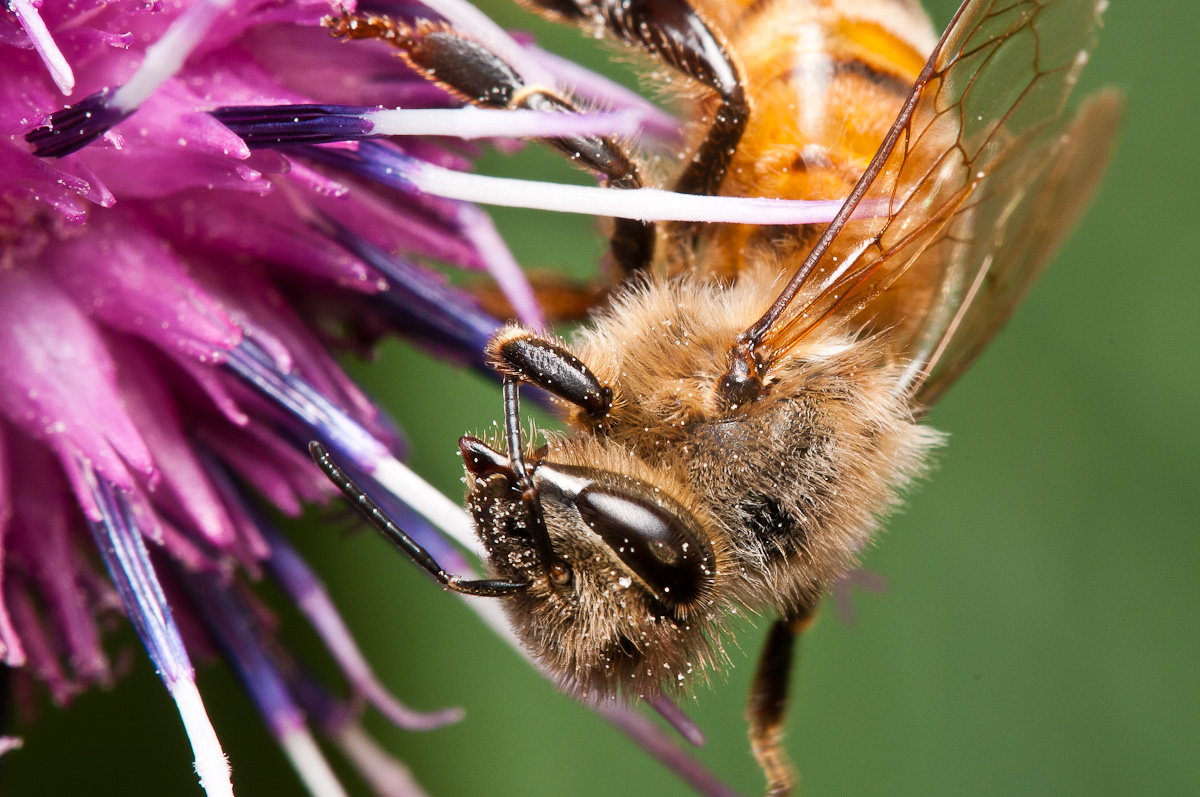
I deliberately kept the focus at minimum distance and focused by moving my body back and forth. That's definitely a challenge and my setup is quite heavy. I was pleasantly surprised at how well the technique works. It's obviously useful for active subjects and for getting closer to small subjects.
While this photo is nothing artistically stunning, the fact that it and some others were fairly well focused and exposed is encouraging. I definitely intend to explore the technique further.
Nikon D300S
Sigma 180mm macro lens
Nikon SB-600 with Lumiquest softbox as main light
ISO 200, 1/200th sec at f/11

Comments
3 commentsYes, you are definitely on to a good technique here. In fact, this is a lot better than just a first try. Your soft box did a good job with the flash. The background was close enough that you lit it up well, too. Dark backgrounds are often the telltale sign of on-camera flash, so your set-up worked well in this case. This is a good basic rig when the background is well-lit. Even though you may end up adding reflectors or even a second flash in the future, for situations where you don't want the background to go dark, this set-up works fine where you need a convenient portable rig, unencumbered by unwieldy attachments. I use a similar rig quite a bit, often modifying the shutter speed to best balance the ambient light.