A View from the Farm
by Tony Kuyper
I moved to the Navajo Reservation located in northeastern Arizona in June 1983, sight unseen, and my first thoughts were about moving back to Iowa as soon as I had the money. The dust was blowing the day I arrived, and the windows in the trailer I would be living in did little to stop it. Many evenings I had to clean a layer of grit off my kitchen table before eating dinner.
Before coming to Arizona, I had never been camping. No Boy Scouts, no weekend family trips, almost no outdoor activities that I looked forward to. Outdoors was chores and fieldwork on the family farm. Working in the summer heat and humidity in Iowa, or the winter cold at the other extreme, can quash the "outdoor spirit" quite thoroughly. It simply wasn't fun. It was work, and we all knew it.
Just prior to leaving Iowa for Arizona, my supervisor, Steve, informed me to be sure to bring my sleeping bag because there was float trip on the San Juan River the weekend after I arrived, and I could go. I was 24-years-old, and I didn't own a sleeping bag. Had never even slept in one. I went out and bought a big heavy bag that was cheap. Steve didn't mention a sleeping pad or ground cloth. I didn't know I needed these, and didn't buy them.
It was a bit warm in my heavy polyester bag on that trip, and a bit hard to sleep on just the sand, but floating down the San Juan River from Sand Island to Mexican Hat was a really, really fun. For perhaps the first time in my life I was actually having fun being outdoors. Hiking, camping, and exploring with friends quickly became my favorite activity away from work.
I've stayed on the Navajo Rez for 26 of the last 28 years (still here), and have very much enjoyed this time and place. There is amazing geology and national-park quality scenery, and it seems there is always something new to photograph. Things are changing though. As certain areas of the reservation are "discovered" by photographers, the "secret" places become well known, and visitation increases significantly. The reservation is not public land, and the local population usually isn't pleased to have it treated as such. As much as I love my photography buddies, I know we're part of a tsunami of bodies and desire that can quickly overrun any place that looks promising for pictures.
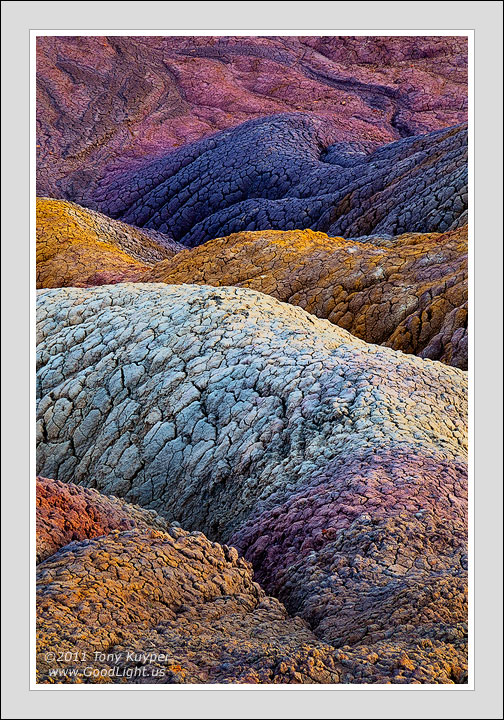
This image is from an area that I visited and photographed several years back. There were earthen barriers blocking access the last time I went. Before they were put in place, however, I had a chance to visit again after developing this file for printing. It was in the spring after a winter of very heavy snow, and the colors and textures were all gone; completely washed out by all that melting precipitation percolating through the soft sediments. There was hardly any color left, and I felt lucky to have photographed it before it all leached away.
Of course, the reality was quite different. It just took me awhile to realize that, no, I was wrong. There was still some color here. It hadn't all melted away with the snow. It's what I had done to the colors in making the print that had changed my perception of the place. The original location just seemed very pale by comparison. I had altered things quite a bit in developing the RAW file, and ended up believing the picture was the real thing.
That's a bit hard to admit, but like the changing access to some of my favorite locations on the Rez, dealing with the truth is eventually necessary. Accepting it and moving forward is the only alternative. I still like this image. It reminds of the special places and special times I've had since moving to Arizona, even though it doesn't accurately depict what's really here. So no, it's not real. In fact, most of my pictures aren't. I can only offer that, for an Iowa farm boy, this maybe captures what it feels like to actually enjoy the outdoors.

Comments
72 commentsLiving in that region must be a double edged sword -- you have a desire to show the beauty of the area, but it's also important not to enable the crowds of copycat photographers that destroy the fragile features that dot the landscape. It's quite sad really what happens to some locations.
Amazing what beauty can be seen out here in what many perceive as barren.
An outstanding composition and backstory. 28 years...you've lived out here longer than you have back east now. Thanks for all you've done for the folks who dwell in your corner of the Nation.
Our senses combine to become our perception of a place and time, our reality, so it makes sense that given your affinity for being outside in this area, that your processed images reflect how you felt at the time of capture. Beautiful image and thanks for sharing your story.
Nick Bristol
Lone Rock, WI
As you say, some of the secret areas are becoming overrun. Glad I live in a state with some major attractions as most people come to Wyoming with the intent of visiting just Yellowstone, Tetons, or perhaps the Wind River Range. Wyoming is a BIG place though and it leaves the rest of the state pretty much open for new photographic exploration. There are areas I will never share with other people due to their fragile nature. I feel bad enough when I accidentally squash a flower or make footprints in an area that has not seen the foot of man in some time. I can't imagine the effect an entire hoard of peeps would make...
Which brings me to another point that I am afraid may alienate me from some of the group here. It is not my intention, just something I have noticed but never mentioned. I understand that people need to make a living, and many do so by leading photographic 'workshops' into public lands. Public lands are open to all, that's a freedom we enjoy. However, are these people paying restitution or taxes or have a license of any type for the use of their ventures onto public lands while making an income? Let alone National Parks. I'm pretty sure to lead legal workshops in places like Yellowstone for example you must be licensed with that park. A person must have a license to use ATVs on public land due to the damage they inflict. Perhaps this is true for people who lead large groups into fragile ecosystems with the intent of making profit? Think I'll email my local government and get better clarification on that...
Again, awesome work.
Here's a quote from Paul Gauguin that I really like and included in my latest eBook as well:
"In art, all who have done something other than their predecessors have merited the epithet of revolutionary; and it is they alone who are masters. "
Guy
However, this has such an abstract quality to the composition that I am not bothered by the hyper-natural interpretation of this scene with the saturation.
The opposite is also true; it would be false to assume that a literal representation of a scene cannot be artistic. I think as artists, we owe respect to and acceptance of each other's work, especially knowing what kind of effort you go through on and off the field to get the photo.
The bottom line is whether the representation is "real" or not (whatever real is) doesn't really matter, what matters is the end result, and the end result here is a successful painting of the scene, with beautiful colours and a well-made abstract.
Chris
BTW, those mushrooms you sent me were great!
The lines and colors are beautiful. Art and truth are moving targets, shades of gray and not blacks and whites. I like the way you've handled it; note that things were altered quite and bit and then enjoy the beauty. (I'm only uncomfortable when an artist states that an image wasn't altered quite a bit, when the truth is the opposite.)
My comment was more in response to what you had said about how your perception of the scene had changed based on the way that you processed the image and how the actual scene was quite different. It was my intent to say that I think your processing works here, in part, because of the abstract nature of the image. As I have thought about it more it is interesting to me how the realistic texture "sells" the realism of the color. As I recall from previous images that you have posted you mention that this color is in fact in the RAW file but that you bring it out by added saturation / contrast adjustments. So in that regard the color is in fact "real" because the various hues were captured on the sensor. Anyway, the point of this is to say that it wasn't my intent to criticize this for being what I called "hyper-natural". I hope it didn't come across this way. Actually, I quite like your style even though it is not always a literal interpretation of a scene and is quite different from what I would capture.
I like the colors.
Looks like a drawing right out of a comic book. I love the comp and the colors are cool too. I does seem a tad bit over sharpened on my monitor. Incredible depth of field as usual. Thanks for sharing the story and a bit of personal info...
Michael
Gary.
As to the subject of these locations becoming more well known - as an Arizona and photography "newbie", I feel like I am part of that problem. I have tried to keep the names and location of these places off the internet but it seems that people will be able to find the info no matter what. I understand the desire for privacy and that the Rez is not public land, but these places are so beautiful I think it is just a shame that no one would ever see them - but when it comes down to it I guess that's not my decision to make.
What I like the most about this post though is your honesty about the processing you have done - what you're basically saying is "this is Landscape ART photography, not documentary photography". I have always admired your sandstone portraits as amazing pieces of abstact art, derived from nature, but have never thought the colors truly represented what was there - to hear you say it is nice. I am now showing my work in three galleries (Flag, Sedona, Scottsdale) and attend openings/artwalks from time to time - the most common question is "do you alter these after they come out of the camera?". I try to answer truthfully - yes they are altered and they are pushed slightly beyond the light and color that was there...but just slightly. I see my "job" as a landscape photographer as trying to convey the EMOTION of the scene. I am standing in a three dimensional world with a view stretching for miles in every direction and feeling this deep connection with this scene and I am trying to represent this feeling on a two dimensional piece of paper that is a few square inches. I do what I feel is necessary in processing to make the viewer of the photo feel what I was feeling when I shot it - I'm not suggesting the photo be used by a geology professor...it's ART!
OK, this is way too long. What I'm saying is keep up the great work both with what you are doing on the rez and what you do with your camera - both are truly inspirational. And let's get out for a shoot someday soon - we're practically neighbors!
BTW, awesome photo.
This whole argument whether the final image represents what one saw, or felt etc... is quite unnecessary in my opinion. At the end of the day we have tools (cameras and processing software) to create art, the same way a painter can decide to create a realistic, or surreal or impressionistic rendition of whatever he/she saw. Do we ever go and question an artist whether his/her painting is an exact rendition of what was seen? Then why should we do it with photography? Such questioning only makes sense if the artist actually states that this is exactly what was seen. If not, it makes no sense to argue or discuss an image with respect to its "reality content."
Beautiful work, Tony, and keep them coming. You are one interesting guy and I sure would like to meet you one day!
Albert Darmo
Abstractland
a bit of your biography.
I admire your work so much because you manage to showcase the desert with such a unique point of view. There are so many photographers who work in the Southwest, yet your images stand out. What an incredible body of work! This photograph is another fine example of what you have been able to achieve.
Thanks for sharing the background information.
Regards.
...and soooo envious you get to live in such a magical place!
Congrats on the WP, though.
Sandy
Albert DArmo
Thanks for sharing some history of you with us! It's really enlightening to have some background. It personally helps me connect more with you and your amazing art.
Wonderful photograph.
Jose