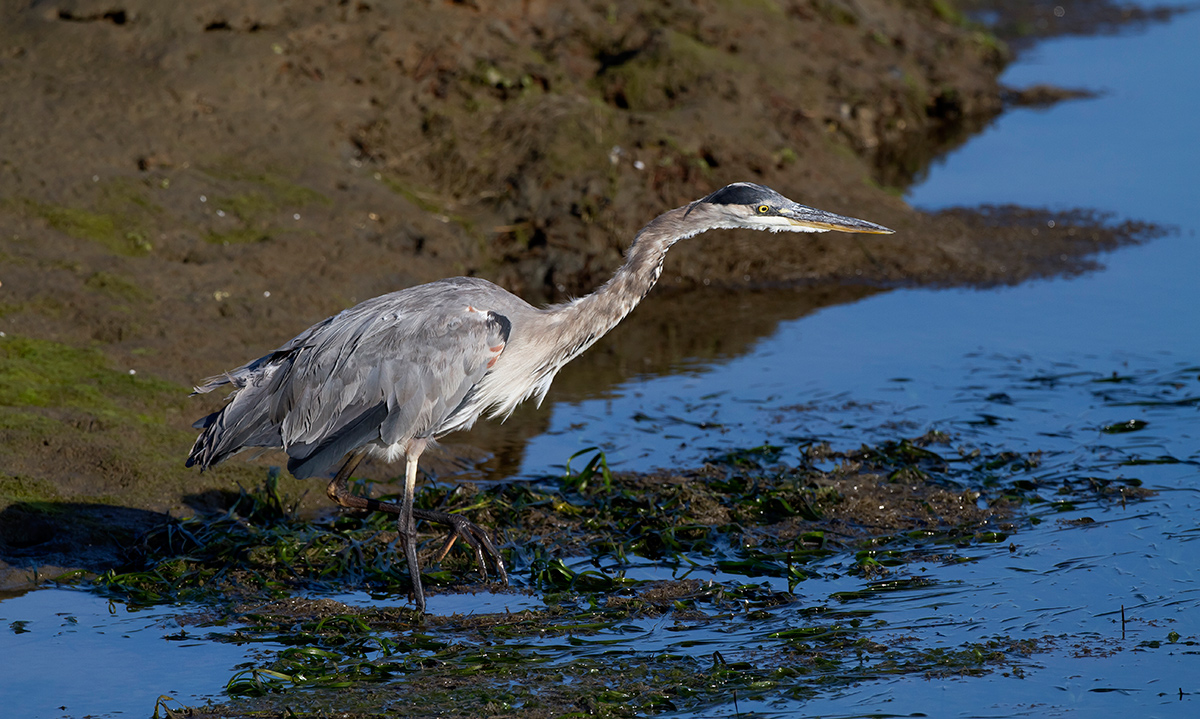
GBH Staring
by Harry Harris
When I was trying to shoot a BB Plover, this Heron showed up and walked fairly close and just started staring. So I tried to compose this image by focusing on the eye and then stop focus. Firs time I tried this. I did crop a little off the top
C & Cs appreciated
08-02-2011
7D with EF500mm / 4.0L
1/2000 at f / 5.6
ISO 400
Manual Exposure
Tripod

Comments
7 commentsDuring the past few weeks, when not giving my undivided attention to my family, I've spent a fair bit of time reading material with a view to improving my camera techniques further, and perhaps the most useful piece of writing I came across was in the following link; seeing as you too are using a 7D I thought you might also find it useful:
http://www.deepgreenphotography.com/2009/12/setting-up-your-new-canon-7d/
Even though I thought I was familiar enough with my 7D, I knew there were at least one or two features I could still benefit from once I got my head around understanding them. One of these is something that's referred to as "back button focusing", something I'd read about a few times previously but hadn't been able to figure out how to use this with my camera, even after following through on the old adage "When all else fails, read the instructions!" ;^p
While Doug Brown (the author of the material in the above link) explains it far better than I can, once you've customised this setting, the duel default operations of the shutter release - half-press for focus; full press for capturing the shot - are split, leaving the only operation of the shutter release now being the full press for capturing the shot, while a button on the back of the camera (conveniently situated close to where one's thumb rests) is now dedicated to focusing. Once you've acquired focus on whatever your target area is, (assuming you're switched to AI Focus) you can release the back button and are free to fire off as many shots with the shutter release without have those awkward moments of having to completely release and half-press it again to reacquire focus should the target have momentarily slipped out of the targeted area.
Once you've locked on to the targeted area, you're also then free to recompose the shot the way you want it, which works particularly well with static subjects. How I've written all this might not make perfect sense (certainly not a first for me!), but I'm sure that reading what Doug writes will and, chances are high, you'll definitely find many of his suggestions extremely useful.
BTW, I can't recall where I found this link myself, as I've done quite a bit of research over the past few weeks on numerous sites, so it's possible I came across it here. If so, and whoever posted it up happens across this, many thanks for posting it up in the first place, it's been an enormous help to me!
Harry, keep up the good work my friend :^)
Ashley: I've posted the link to Doug's excellent article a couple of times in the forums. Doug and I are both from Albuquerque and we photograph together quite a bit. The article is posted on Greg Basco's site. Greg, Doug and I have photographed together in Costa Rica a couple of times as well. Glad you found the article and especially glad you found it useful.
PS. I'm going to edit your post and turn the text for the link into a hyperlink for easier access.
Thanks also for creating a hyperlink; couldn't figure out how to do it myself.
where you can find tones of informations from cameras, lenses, settings and other cool helpful reviews.....
Cheers and thank you for sharing !!!
Regarding the links: this is the first time that I've seen both of them. There is so much published on this website and elsewhere that a little repetition is a good idea to make sure that we eventually see it! The second link was mostly hard to read (since no matter how I used it, the published link sent me to an Italian version of the website)....until I figured out that the following link gave me the english version:
http://www.juzaphoto.com/index2.php?l=en&pg=home
and that site looks great! Thank you for all this!!
I love the dishelveled look the heron has, the stalking pose, sharpness and detail in the plumage. I also like your composition. I might desaturate the blue channel slightly as I can see blue in the shadow of the heron, minor thing really. I like the background and how the head of the bird is nearly centered in that little brown spit of mud.