Page Power Plant
The Navajo generating station near Page, Arizona is a familiar site to anyone who has visited Antelope Canyon. It's right alongside Highway 98 just a few miles southeast of the town and towers over the canyon and its parking lot. Running full-tilt, some environmental web pages claim it produces 19 million tons of carbon dioxide annually, the equivalent of 3.5 million modern automobiles. (Nineteen million (19,000,000) tons equals 38,000,000,000 (38 billion) pounds.) It uses 8 billion gallons of water from Lake Powell for cooling. It burns through 25,000 tons of coal a day from mines on Black Mesa and provides power to Arizona, Nevada, and California, with the LA power district receiving 21% of its output. These statistics come from environmental websites, but even if these values are cut in half, this one plant has quite an impact on the environment.
Scrubbers were installed to remove sulfur dioxide during the three-year span from 1997 to 1999, and this has decreased pollution monitored in Grand Canyon, according to the
Desert Research Institute in Las Vegas, NV. I am not familiar with this organization. However, the power plant has always produced a yellow haze that wafts for dozens of miles, generally in the direction the wind is blowing. I'm told this is from nitrous oxides produced by burning coal and that these compounds are not removed by the scrubbers. The yellow haze can frequently be seen from the rim of Bryce Canyon, between it and Navajo Mountain in the distance, and also from Desert View at the south rim of Grand Canyon.
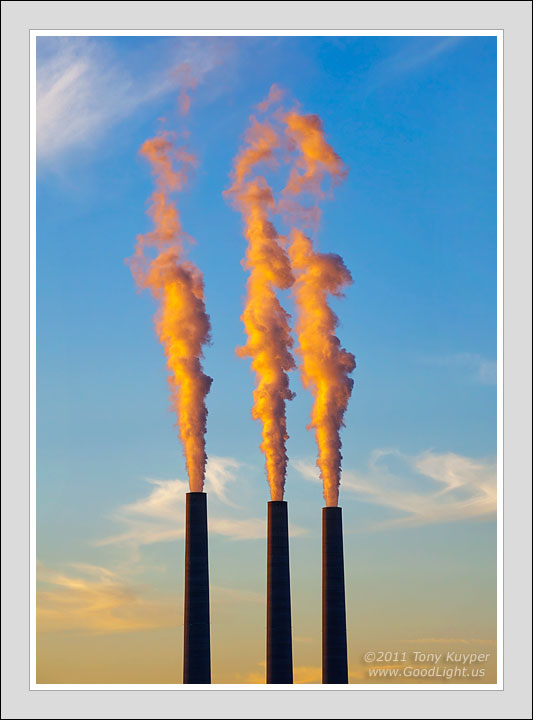
The scrubbers inject a water-based chemical solution into the exhaust stream. The chemical combines with the sulfur dioxides to form compounds (I'm assuming non-gaseous precipitates) that are then captured and not vented with the other exhaust gasses. One of the consequences of introducing water into hot exhaust is the production of steam, and this can be seen billowing from the smokestacks on most days, and more copiously in the winter when the weather is cooler. This image was taken on November 1, 2010.
The steam is typically white as it condenses after emerging into the cooler atmosphere above the smokestacks. However, as I was driving into Page one day, I saw conditions developing that might change this. I stopped my car and waited a few minutes, and sure enough, the change occurred, but it only lasted for a couple of minutes. The orange color is sunset light on the steam.
This was a very calm day as can be seen from the emissions simply rising straight up from the smokestacks instead of leaning one direction with the wind. The yellow, nitrous oxide haze, which likely contains other not-so-healthy substances, seems like it is settling right around the plant, instead of being carried away with the winds. This colored haze is typically seen blowing away from the plant. When you're actually in or beneath the haze you don't really notice it visually, but from a distance, as you look through its depth and compare it with the "normal" sky, it's quite obvious.
At some level, I think the power of environmental journalism is its ability to shock the viewer into confronting the reality of the situation. I must admit that I prefer to make "pretty" pictures, so this likely lessens the impact this image may have on the viewer. However, if it gets people to look at something that is often overlooked, then maybe it can be successful in helping us think about where it comes from, why it's here, and what it may be doing.
Canon 5D2, 28-200@200mm. Photoshopping for this image is at the bottom of
this page.

Comments
14 commentsI'm uncertain of the source, but a similar haze often blankets the whole of the Canyonlands/Arches/Natural Bridges/Capitol Reef region. I'm wondering if it too includes a fair portion of sulfur dioxide due to its yellowish color and propensity for turning blue skies green.
Nice (and effective) write-up to go with an effective photo. The two together will have a powerful impact on viewers I think.
Too bad it isn't located in a more uninhabited area and more distant from any of our natural icons.
Congrats on the EP!
Sandy
Sandy
~~Tim!