BUBBLES!!
First off - my thanks to Scott Miller for posting his excellent image "Bubble Feeding Whales" - seeing that image got my slow-working brain going and eventually I recalled I had a few of those bubble-netters in my collection (sitting there in unprocessed raw form!).
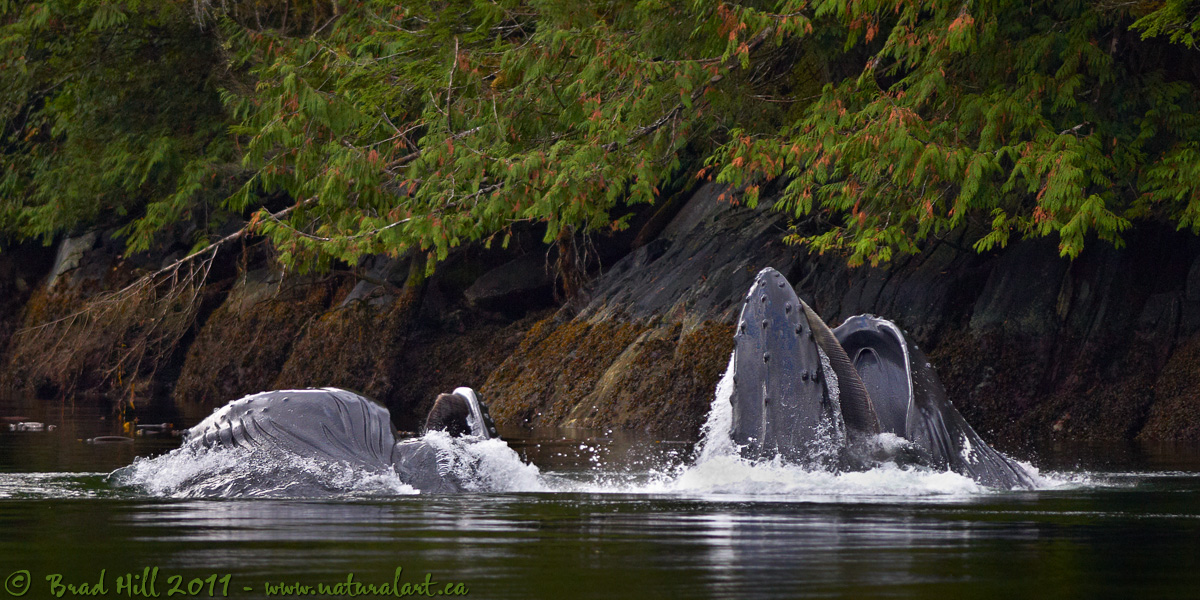
Watching Humpback Whales bubble-netting is an amazing experience! And, it can be a real challenge to photograph as the action happens REALLY quickly and the whales can surface almost anywhere when they're engaged in this complex behaviour. This image was shot from the deck of a sailboat and our efforts to photograph the behaviour was as much as a cooperative effort as the bubble-netting was - we had about 8 pairs of eyes watching in ALL directions for the tell-tale ring of bubbles that rose to the surface seconds before the whales emerged in the middle of the ring. So we quickly got in the habit of silently watching until someone saw bubbles in a circular pattern - at which point they screamed out "BUBBLES" to alert everyone to the pending action.
Bubble-netting by Humpback Whales is an amazingly complex foraging behaviour that involves tool use (and, technically, tool construction) and the cooperative behaviour of two or more individuals. At its simplest, the behaviour involves whales seeking out a school of herring or other small fish, followed by swimming in a circle under them while exhaling air to produce a rising "bubble net" that traps the herring, then rising through the school with mouth open to capture the herring in the their massive mouths. The whales then close their mouths and filter the water through the baleen plates on their upper jaw - thus expelling the water while retaining the fish for consumption. And if that isn't complicated enough...it turns out that there actually is a whole lot more going on! During a typical bubble-netting event several whales coordinate their swimming in a way to contain the fish while another whale swims deep underneath the fish. Then the whale deep below the fish emits a stunningly loud sound (basically a huge burst of sound or a scream) which may function to further assemble the other whales or to signal them to rise or even to confuse or stun the fish in the bubble net. Studies have shown that the "screamer" whale is the same whale each time - kind of like a designated quarterback! So with bubble-netting we have tool use (the building of the bubble nets), coordination and cooperation of behaviour, vocal communication, and even division of labour! Pretty mind-blowing when you think of it - makes one wonder what else we still have to learn about the social organization, behaviour, and intelligence of these amazing (and other less-studied) whales!
Back to photography! One of the most common reasons given for shooting raw images is that over time the software used to process the image files is bound to improve and we'll be able to extract "more" out of them as time goes on (assuming you save them and assuming you can find the time to go back and give those "archaic" shots a new effort). Well...with this shot I can say this promise has come true. I captured this image back in 2006 using a camera that was a fine one in its time, but at ISO's beyond about 200 the dynamic range fell VERY quickly. This image was shot at a sky-high ISO of 400 (400, NOT 4000

) and even at this ISO the whites in the foaming water were SO blown out that they functionally ruined the image (regardless of the "tricks" I used to bring back highlight detail during raw conversion or in Photoshop). But...when I recently re-processed this image (spring of 2011) using updated and current raw conversion software...well...the whites were "tamable" enough that the image is now presentable. I would still prefer a little more white-on-white detail in the image (especially in the foaming water below the whale on the right), but it's the kind of thing that MOST viewers wouldn't notice unless I pointed it out to them (especially given everything else to look at here!).
The take home lesson? Well...if you have the time and sufficient technical interest and aptitude to do so, it really is worth shooting raw files! And...it IS worth keeping those marginally blown shots in the hope that in the future they may be salvageable!
Subject: Humpback Whales (
Megaptera novaeagnliae) bubble-netting
Location: Great Bear Rainforest, BC, Canada
Camera: Nikon D2x
Lens: Nikkor 300mm f2.8 VR - handheld from sailboat (VR on an in "normal" mode)
Exposure: 1/1000s at f2.8. ISO 400. No compensation from matrix metered exposure.
Crop: About 85% of full frame horizontally (and additional cropped from top & bottom to produce pano)
All the "usual" additional info about the image (including processing information) on my website right here...
http://www.naturalart.ca/galleries/latest/detail_2.html.
Comments & critiques welcomed. Probably better to view larger version first...
Cheers...thanks for looking...
Brad

Comments
11 commentsPeter
Phil: Thanks! I consider myself more of a conservation photography than a wildlife photographer, and I believe that you have a better chance in creating concern for wildlife among "non-believers" if they find the animal interesting or, better yet, fascinating. Similarly, I try (usually unsuccessfully) to try to convey a sense of personality in my images, largely for the same reason (so those same "non-believers" can relate better to them). Obviously this shot doesn't convey anything about the whales' personalities, but watch for my next post in a couple of days to see what I mean. And, I DO enjoy teaching, but only about things I'm passionate about (like wildlife photography!). I always try to do a significant amount of research on a species before I photograph them to help me get the most out of my time in the field with them (and to watch for interesting bits of behaviour). Being a biologist by training doesn't hurt!
Peter: RE: "...can you remember how far from the shore they were?" While there is a LITTLE compression pulling that shoreline in closer, they were amazingly close to that shore (and it IS a veritable vertical face below the surface). Based on this image and my memory I would say they were no more than 10 meters from the shoreline. There were only two whales working together here to "corral" the fish (and, as shown in Scott's shot, there are often many more whales than this working cooperatively when bubble-netting), so it's possible they were using the rock face to help constrain the fish - but this is pure speculation on my part.
Luke: Yes, I like Scott's shot too.
Cheers...
Brad
Thanks for the posting, love the explanation. I touched on some of that in my comments thread from my first posting, but didn't go in to nearly as much detail.
Your comments in detail are very informative as usual.
Jagdeep Rajput