Yellow-headed Blackbird
by Nate Chappell
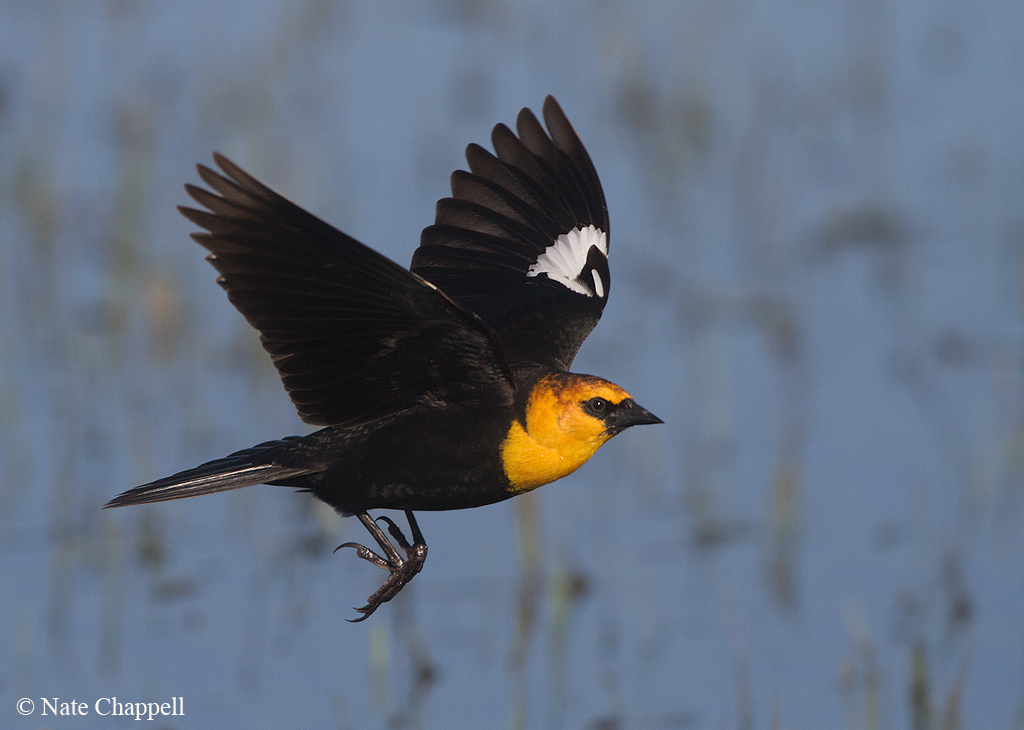
I've just returned from leading a trip out at Malheur refuge in Eastern Oregon. The day before it started I spent the day scouting around Burns, Oregon finding where the birds were. The flooded farm fields around Burns are excellent in the spring, they attract a large variety of waterbirds as well as lots of these guys. A couple of these males would display on the fence line and then fly across to the field, when they flew back to the fence line I would catch them in flight on their return. This is about 55% of the original frame. I reduced the saturation by -12 in ACR to retain the detail in the yellows.
I had just purchased a 7D and this time I got a good one. I had received a defective one last summer and returned it. I'm pretty impressed with the AF on this camera.
7D 500mmF4 1/3200 F5.6, iso 320, evaluative metering -0.3, handheld, AI Servo.

Comments
28 commentscheers
Rob
I especially like the color/great exposure of this difficult subject.
Hat's off!
Jagdeep Rajput
someday. Just wish I had more time to spend on photography.
Ron Huff
Ralph Kerr
Ralph, thanks, it was great to meet you and work with you.
David, we did stay 3 nights at Frenchglen so that probably was us.
Smoking Catch Nate
Ken Archer
I look forward to seeing these birds in Wisconsin in a few weeks.
lucy
I have a question for you: Did you reduce the saturation on the image as a whole or only on the subject?
Reason I ask is that the setting (while visually pleasing) seems much darker than I would expect would allow a shutter speed as high as 1/3200, assuming of course that you were in aperture priority, more especially seeing as your ISO was only at 320.
You and I are using the same tools and yet, unless I'm shooting a subject set against a bright sky, even with my minimum ISO at 400 in relatively bright daylight, if I'm shooting a subject in aperture priority that's set against seemingly any other backdrop, it's exceptionally rare for me to acquire a shutter speed of more than 1/2500. And at the risk of driving you and other people who've patiently been through this with me before completely mad ;^. I have to admit that in the latter scenario I still opt for shutter priority, as in most cases in my experience it's the only way to ensure the shutter speed will be over 1/1000, giving me at least some hope of freezing a sharp image of a relatively small bird in flight.
I spent another four hours yesterday with my Indian Rollers (over the past week I must have invested at least 20 hours trying to get perfectly sharp in-flight shots of them, yesterday I came the closest with a number but yet to hit perfection!) and in the latter setting I described there's just no hope of me capturing them with the slow shutter speeds aperture priority offers and I'm loth to increase my ISO higher than 640 for the terrible noise issues it introduces.
Apologies for the length of this Nate, but I figure I'm best off writing about this issue until (hopefully) something clicks whereby I can understand what I'm doing wrong in aperture priority, if anything, or whether it's simply a matter of varying light conditions that even the most experienced wouldn't be able to acquire sharp shot of wings and subject in motion and, perhaps, wouldn't even bother try going for.
I did reduce the saturation on the entire image which is rare for me to do except when I'm trying to hold detail in yellows or reds of a bird. This was quite a bright scene, the negative exposure compensation and reduced saturation brought down that brightness some.
I was shooting in bright sunlight in an open area and to keep from blowing out those whites I dialed in -0.3 exposure compensation, this helped increase the shutter speed a bit. I think it's just varying lighting conditions (or possibly not using a small enough F-stop) that is keeping you from getting that type of shutter speed in aperture priority. At Beung Borapet after about 8am I was able to get these fast types of shutter speeds on sunny days when shooting in aperture priority.
You probably already do this but when I'm working in aperture priority and I'm at the highest iso level that I like to use I would first decrease my depth of field (F-stop). Then if I still don't have the shutter speed that I desire I will bite the bullet and increase my iso.
As I mentioned earlier if you think your subject might be going through various backgrounds it's better to use manual exposure but the same thinking as above applies regarding F-stop and iso.
You can get the same shutter speed if you are working at the same aperture in either shutter, manual or aperture priority. If you are underexposing the image when working in shutter priority to get a fast shutter speed I think you would be better off and have less noise by increasing your iso.
Truth be told, for all the countless photos I took up in Bueng Boraphet at the end of last year, there's barely a handful I'm happy with. But I reckon I've learned a great deal since then and look forward to my next opportunity probably in about a month's time. You're right about the light being bright after 8am, as I recall I was constantly battling with exposure compensation particularly with the white egrets.
I'll keep working in aperture priority in line with your suggestions, although as a failsafe I'm pretty sure I'll fall back on shutter priority whenever I see there's no way I'm going to be able to freeze the action with whatever the best shutter speed aperture priority will provide.
May