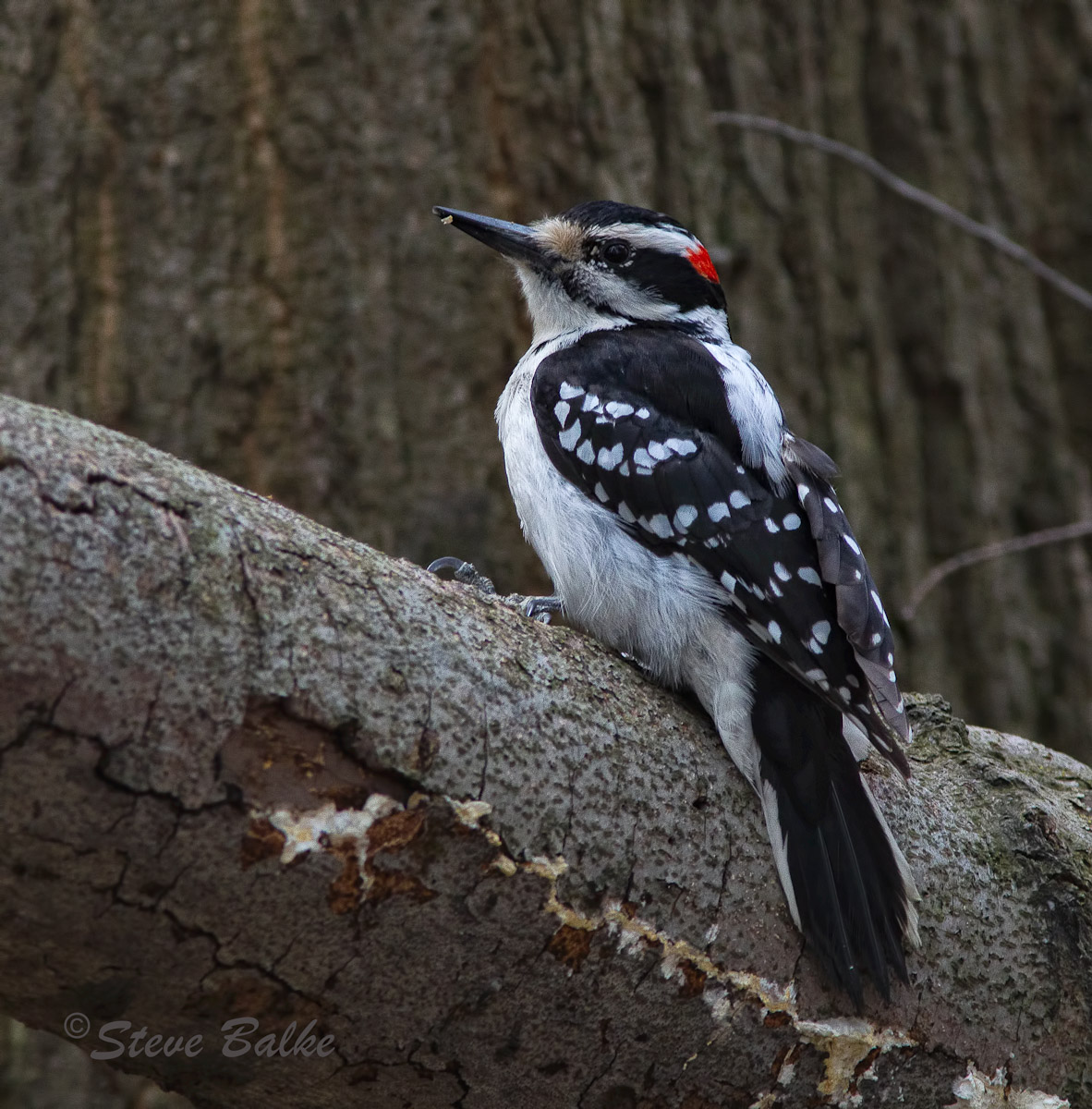
Hairy Woodpecker
by Steve Balke
Apparently the name of this woodpecker originates from the "hair-like" nature of the feathers on its back (as opposed to the soft, smooth feathers on its close relative, the Downy Woodpecker). In dead specimens the difference is evident; it's not so evident in live ones!
Anyway, as I mentioned earlier, there seem to be plenty of them around here these days. This fellow was curious enough to pause for a moment.
Pretty common bird subject in this gallery……but I rather like this image and wanted to share it.
All comments very welcome.
1D Mark IV, 400 mm f/5.6, 1.4x TC, hand held: ISO 1250, 1/1000 s, f/8.
[I've decided to cut out some info: you can safely assume that all of my images have been subject to NR, exposure adjustment and sharpening. Also, I note that many of you don't specify percent crop. I'm going to join that crowd because I'd like to know what you think of the image quality regardless of whether you like the crop size or not. I'm happy to state the crop if you spot some quality defect that you think is due to cropping. However, I'm hoping that this will start us thinking about other causes of image deficiencies and maybe even help clarify (to me at least!) what is a deficiency due to cropping.)

Comments
23 commentsThere's not as much detail in this as I'd like to see for a bird so large in the frame, and there is amount of noise present in throat and throughout the gray areas of the white feathers.
Whatever texture existed in the woodpecker plumage hasn't been captured (missed critical focus, light too flat, slight camera/subject motion, whatever), it has been masked by the noise at the high 1250 ISO setting, or it has been removed by the application of noise reduction.
You shouldn't need diagnostic tools to find the noise - it should be visible to your eye jut by looking at the image.
Why? I almost never use NR and I doubt if many others here at NPN make it a regular step in their image processing. There's none applied in my coot image as it wasn't needed: a modest ISO 400 in decent light and an exposure that didn't need to be boosted in raw conversion.
Just because you end up with the same number of pixels after cropping that I started with using the old D70 doesn't mean that you get the same resolution. By cropping you are asking more of your optics: effectively lowering the resolution of the lens by making it deliver the image you use to a smaller sensor. By shooting at a rather high ISO you further reduce overall resolution of your system. By using NR on the image to eliminate even more resolution.
Not sure why you would need to use NR on all your images, especially when you are shooting the Mark IV. I have shot at ISO 1600 with the Mark IV and not needed to use NR as long as I did not crop down to less than 60% or so of the original frame and the exposure was good. I shoot ISO 800 a ton and even with 45% crops I don't use NR. Now, I do shoot a bit on the bright side to help the noise issue as any underexposure will bring out more noise when you bring the exposure back up to the correct level in post processing. You might want to try shooting a bit bright to help reduce your need for NR. Just a suggestion.
a. Richard
i. Your Coot shot is really beautiful. There is a better chance of course of having more detail visible because you have more bird pixels at full frame. However, as you mention, it ain't necessarily so. Lighting, camera settings, etc. come into it too. Also, an American Coot is not a Hairy Woodpecker. We know that some birds show better feather structure in an image than others. Hairy Woodpeckers have been posted often on this website. I like shooting these fellows and would like to know your ideal of what good detail represents for them. Can you point to any full frame (or otherwise) shots of this species that you prefer for detail?
ii. Regarding noise, since this image looks fine to me from a noise viewpoint and not fine to some of you, I obviously need to increase my ability to see noise. Also, I like the advantages that large crops offer and want to figure out how best to overcome problems associated with them. The tools offered in the software that I mentioned accomplish that. I just need to take the trouble to use them more extensively.
iii. Regarding the application of NR: the software allows me to tailor the NR from almost nothing to very significant. I can judge noise and effect on detail very well. We know that the eye is very sensitive to color noise in particular and that there are so many variables affecting noise level. So, what I normally do is, if I see nearly no noise (I think I can usually spot something that looks like noise), I run the lowest possible NR setting. I then check the detail and invariably see no effect. It seems to be working well for me, Richard. I know that you don't like this shot but I have published some that you seem to like and that originated from this approach.
iv. Regarding resolution after cropping and post-processing: Well I guess the proof is in the pudding. Cropping give me flexibility in composition and allows me to hike carrying a reasonably light lens. It goes without saying that I always try to get close to the birds. However, they don't always cooperate….. So, sometimes it has to be a highly cropped, interesting image or a dull distant one. Analogous things can be said of my use of high ISO. I've tried to minimize the limitations with the best equipment that I can obtain.
Ron B
i. I've noted before how I do tend to post darker images than perhaps I should. My monitor is calibrated too. I think I likely just prefer them. However, I'll try to pay more attention to that aspect in future.
ii. I don't feel the same aversion to NR as you (and Richard) do when used as I describe above. I normally shoot Raw and I see no reason to depend only upon hardware and settings to provide minimum noise. I understand the concern for image degradation due to NR. However, I think I'm doing more good than harm with my approach. I'll keep monitoring it though and, especially with these comments from you two, will be even more wary.
iii. Incidentally, I took your previous comments to heart, Ron, and tried shooting to the right more often. However, in this case full aperture (f/8.0) was what I was stuck with because it was such an overcast day.
Thank you both again. I do welcome your very constructive and very helpful comments. To be continued...
6MP is 6MP; at least I thought that was the point you have been trying to make for some time, and that's why I made the comparison of my 6MP coot to your 6MP woodpecker. Forget the feathers for the moment and compare any part of your 6MP image to any part of my 6MP image for detail and amount of noise.
All pixels are not the same. The D70 spreads its 6MP over a sensor 23.7mm by 15.6mm; your 2446x2483 crop from a 27.9mm x 18.6mm sensor means you have effectively used a sensor that measures 13.9mm x 14.1mm. That cuts down the resolution of your lens (line pairs per millimeter) and makes the inherent noise of the smaller photosites more prominent.
Yes, feather structure is different for some birds: Cedar Waxwings almost always show little feather texture while Verdins are at the other extreme and show a very coarse texture.
A quick search in the Avian Gallery for Hairy Woodpecker brought me to this one from Jim DeWitt. Hand held, 600mm, 1/50th second, dim light, smaller sensor. I think it shows better feather detail. More noise as well, but more texture with it.
I agree there are many advantages to large crops: you don't need to get as close physically or optically and I know how seductive that can be. But I don't think there are software tools that will overcome the disadvantages of large crops: loss of detail and increased noise. There's no way to put back detail that wasn't captured originally, and I don't know of any NR application or plugin that does an effective job of taking out noise while leaving detail intact. The only way I know to overcome the downside of massive cropping is to get closer to the subject and not do the massive crop.
I don't know of any NR application or plugin that does an effective job of taking out noise while leaving detail intact. For me. NR is a last resort when I've been forced to use an ISO setting higher than my camera should use, or when I've screwed up my exposure and needed to pump it up in raw conversion.
I agree: the proof is in the results. I would not be satisfied with results in my images as seen in this woodpecker post.
There's a third choice you've not mentioned with your "highly cropped" or "distant subject" pair and that's "no image at all." Its the choice I make when I can't get close enough to my intended subject.
This comment only made sense to me if you had been shooting in shutter priority, and checking your EXIF on the large image I see that is the case. You could have given more exposure at f/8 simply by changing the shutter speed from 1/1000th second to 1/500th second.
i. I think that you've misunderstood the point I've made in the past: I've noted that the more pixels that represent the bird the finer the detail that can potentially be resolved. However, sometimes we don't need that many pixels to see observable detail. And, as we noted, the visibility of detail and noise depends on several variables (including the species of bird). Resolution is not the whole story. All I am asking is that we keep an open mind about the quality of highly cropped images. We can say that, all other things being equal, then a full frame image is potentially always of higher quality than a highly cropped image (although the quality difference may not be discernible). However, in practice, all other things are not equal. Your American Coot image might be showing low noise and high detail more because of lighting than anything else. Also, I expect that often the highly cropped image can well provide a perfectly acceptable image and one that the majority of NPN photographers would consider high quality. By not stating the percent crop, even for highly cropped images, until the conclusion of reviews we can test this idea.
ii. You're point about cropping making the noise of the sensors more prominent is interesting but puzzling to me. I'm not cropping by reducing sensor size (as in a non-full frame camera for example); I'm cropping by snipping some of the image away. The various origins of noise have already done their work. By cropping, I'm just looking at the image with a magnifying glass. Maybe I'm missing something here. So, don't hesitate to send me more info on this, Richard. If I'm wrong I'll add it as a comment here. By the way, I do agree that all sensor elements are not equal amongst different cameras and have previously made that point in objecting to depending only on percent crop to indicate image quality.
iii. Thank you for finding Jim's woodpecker shot. They are very close…….and I do see better detail in the black tail.……due to cropping….or lighting…..or what….Anyway, I'm happy to see a woodpecker image that you consider superior to mine (but I like mine better……[smile, Richard]).
iv. Have a look at Topaz DeNoise 5 and listen to the two part in-depth video tutorial on their website (by the author of the software I think). You may become a convert.
v. Sorry you don't like my woodpecker image, Richard. I hope that, if future, you will continue to et me know when you do like one………even though it may be a highly cropped image that you are looking at!
vi. It was shutter speed priority. Especially with woodpeckers, I like to operate at 1/1000 s. This fellow sat pretty still. So, it is true that I could have switched to manual or aperture priority……but there wasn't much time…..and I liked the results. I think 1/500 s would have resulted in motion blur…..from me holding the 560 mm lens.
Thanks again, Richard. This is sure giving this old brain of mine a good workout!
Nice image of this Hairy. I would brighten this up a bit. To my eye the sharpest part of the plumage is the head which looks very good. The detail in other parts - particularly the back doesn't look as good. This and the fact that you were shooting wide open leads me to believe it may well have been a depth of field issue rather than a crop and/or noise reduction issue. This often happens to me if I shoot wide open and focus on the head. That's why I like to stop down a little bit even when I'm working in low light but I do understand you are shooting handheld and wanted to keep your shutter speed up as well as the fact that the light was limited as shown by your iso. So given your shooting style this was probably about as well as you could have done given the conditions and it's a good but by no means perfect image.
I use noise reduction on images when it is needed and if it improves the image. If done skillfully and correctly it can remove very little detail. I know you shoot handheld in the woods on a regular basis and that being the case you are going to need to keep your shutter speed up and shoot at high isos sometimes. Hence the need for using noise reduction often. It's certainly much better to have a sharp image that you run a bit of noise reduction on than an out of focus one. This is certainly different than someone who, for example, shoots in a sunny, open environment with a tripod.
I certainly have no problem with you not posting the crop percentage. It's not and never has been required by the posting guidelines. I do think it's generally helpful for avian image critique but you've certainly explained your reasoning well. And there are plenty of areas to focus on in critique which are important to the image besides feather detail including composition, brightness, color rendition, action (or lack thereof). In the end if you feel you are getting more out of the critiques by not posting your crop percentage, then that's great, more power to you.
Cheers,
Nate
Your reminder of the wide diversity of photographers represented here really does help us to better understand the attitudes expressed here and the differences in preferred approaches.
Regarding % crop: before deciding to omit it from my figure caption I checked the posting guidelines quite carefully and examined many posted images. However, it's good to know that, as moderator, this is also o.k. with you. Also, please note that, as I did with this image, I'm willing to specify the percent crop at the end of the review period. To reiterate: the idea here is to have assessments of any properties of the image (including, maybe even especially, feather detail) without the bad reputation of large crop images affecting the assessments. I think that we will all learn more this way.
Your comment regarding a possible DOF effect is exactly the kind of comment that's particularly helpful: it specified the properties of the image and proposed a plausible reason. I sure try to make such comments and I hope that this interchange over specifying % crop does not discourage anyone from making such comments about any aspect of my images. I think that feather detail is one of the most important of all properties and certainly the one I am particularly interested in preserving after a large crop.
So, we shall see……
If you want to debate what info to provide and what not to provide in the post please do so in the discussion forum. Steve has explained his reasons (which he didn't even have to do) and he has every right to disclose or not disclose the crop size as he sees fit. It's his post and if he feels he's getting more out of it by providing or not providing any info that is the member's discretion, not the people critiquing it.
Steve, I think asking how much of the original frame is represented in a photo is 100% fair game;
1. Based on the focal length used, it will allow other members to get a feel for how close you were to the subject. After all, field craft skill and the ability to get close to a subject (in an ethical manner) is an important part of wildlife photography!
2. By specifying how much of a crop, it will allow those providing a technical critique to properly frame their comments. For example, the noise and "muddy detail" (for lack of a better way to describe what I see in this photo) tells me that based on the equipment used, this is a substantial crop. My comment on this photo might be - "I'd like to see another crop with the bird smaller in the frame." If we're not going to take crop into account, I wouldn't be able to offer that suggestion.
Finally, and this is just my own personal opinion and FWIW, major-crop photos of wildlife is sort of "gaming" the true intent of this gallery - learning and discussing all the skills/techniques of wildlife photography to produce great photos. I could theoretically take a shot from the side of the road in my car with a 100MP camera of a distant subject, crop the heck out of it and make it appear that I actually used field craft skill to closely approach the subject. I know this is somewhat a far-fetched point, but if we all began to take this approach, the person with the biggest camera and best PS skills would have a significant and IMO a somewhat pointless advantage. Luckily, at least at this point in the evolution of digital technology, major crops remain apparent in most cases.
I do not wish to make "percentage of crop" a requirement in the Posting Guidelines, but on the other hand I agree that it is a fair and useful point to consider when assessing a wildlife photo. I'm inclined to agree that when asked "how much of a crop" the photo represents, that the OP be forthcoming with that information.
I wanted to show this image http://www.naturephotographers.net/imagecritique/ic.cgi?a=vp&pr=169828&CGISESSID=852b1d06327a20e722924306fc276393&u=15342 as a reference frame for your shot.
I calculated the exact crop percentage on this and this is 44% of full frame (I had estimated 50%). It's taken with the same camera and teleconverter as your woodpecker shot. It was taken with a 500 F4 as opposed to a 400 F5.6 and it was at 800 iso. I did use noise reduction on the whole image during ACR conversion with settings of amount 25 and retain detail 90. So there are some differences in techs and equipment between our shots but they are not huge. One big difference is that I stopped down 1 full stop. I find with that camera or the Mark III which I usually shoot with and a teleconverter that I get sharper images if I stop down to at least 2/3 of a stop even if I'm handholding and it means a slighly slower shutter speed or having to increase my iso.
With the Mark IV and some of the other newer cameras it's certainly possible to get crisp, well detailed images at crops of greater than 50%. I personally think the image quality is much higher on a file that is 50% of the Mark IV (8 megapixels) than a full frame Canon 20D file taken at the same iso. I am confident my findings would be the same if I compared a Nikon D3 or D700 file at 50% to a full frame D70 file taken at the same iso. So there is certainly some legitamacy to what you say about the camera or equipment used making a difference.
All that being said I certainly strive to get full frame or close to full frame shots whenever I photograph birds because obviously then the detail and file will be even better and I get satisfaction from getting a good full frame image.