Two Worlds
by SandyRichardsBrown
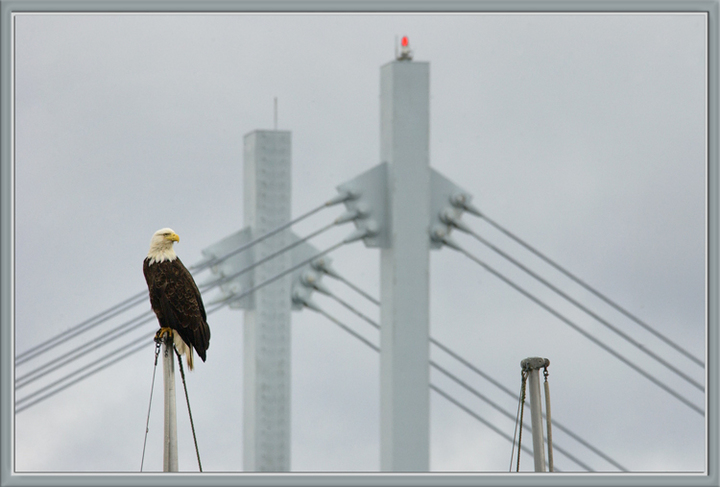
This was taken a few years ago in Seattle, from my boat.
It always saddens me to see wild creatures so acclimated to humans and human contraptions.
On the other hand, the abundance of Bald Eagles in many places now is also a testimony to the great success of protection and recovery programs, and the banning of DDT.
In 1940, Congress passed the Bald Eagle Act, which gave special protection to the birds and their habitat. Legislation helped alleviate some of the direct human pressures, but at the same time DDT use was becoming more widespread in its use. In 1967, the bald eagle was given special protection by the federal government under a precursor to the Endangered Species Act. The bald eagle was one of the first species added and protected under the Endangered Species Act when it was enacted in 1973. Slowly, under federal protection and aided by a landmark decision by the Environmental Protection Agency to ban DDT in 1972, the population of breeding pairs increased in the wild. In 1995, bald eagles were changed from the status of endangered to threatened before being removed from the endangered species list completely in 2007.
As of 2010, populations of bald eagles in the wild are strong and healthy. Bald eagles pair with another eagle for life, and populations of the bird were only around 500 breeding pairs in the 1960s, according to the U.S: Fish and Wildlife Service. Currently, there are now around 10,000 pairs of bald eagles mating in the wild thanks to federal protection and conservation efforts.
For those interested, here is a live "Bald Eagle 24-hr Cam" :
http://www.outdoorchannel.com/Conservation/EagleCam.aspx
near Washington, D.C. Eggs are laid, parents incubating, and chicks should hatch in about 3 weeks (35 day incubation period)
the old D1X
100-300mm @ 280mm
1/320 sec, f/8
Mode: Program
Metering: Spot
Exp comp: +2/3
ISO: 500
AF mode: AF-C
Drive: Continuous
White balance: CLOUDY
Flash: Off

Comments
11 commentsWe have over 1,000 hanging around Kodiak city each winter to feast on scraps from the fish processing companies, and biologists speculate that the population over a broad local area is above natural levels simply because of the artificial winter food source people provide. It's not unusual to see over 100 sitting shoulder to shoulder on the roof of a single cannery waiting for their next "course" to be delivered by the next boat arrival. There have been lots of changes in cannery operations to keep the eagles from hurting themselves, but they're devoted dumpster divers and not nearly so photogenic!
Great information as well. Agree with your opinion on wild animals acclimating to human "things", but also agree it's sometimes just nice to see and know they are surviving as their wilderness dwindles.
Lived and worked in a few large hospitals in NYC during my younger years (before my passion for photography) and can recall seeing Hawks fly past the top floor windows where they nested among the roof top/top floor window structures. A beautiful sight to see - such a large bird fly sometimes right in front of you, especially if you happen to be standing by one of the windows they where nesting near.
Thanks again for the post.
PS - what kind of boat do you have?
interesting story and very nice shot. Congrats on EP.