Gallery: LandscapePosted November 15, 2010141 views6 comments
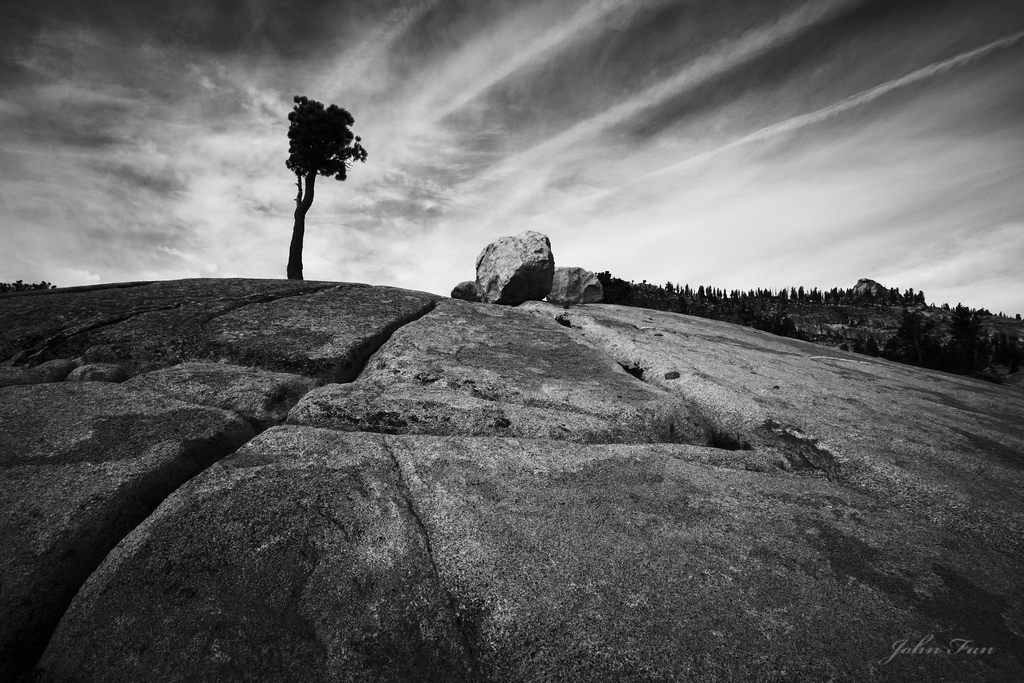
When I traveled to Yosemite, one thing bothered me was that airplanes always leave cloud trails all over the sky. But I found one instance where they actually worked. Sometimes, I just have to take what I get.
Sony A900
16-35mm
Comments
6 comments
Comment posted by Richard Teller on November 15, 2010 at 11:48 PM
Interesting image. It a a real feeling of depth.
Registered on August 23, 2010, 1162 Posts, 6692 Comments
Comment posted by Preston Birdwell on November 15, 2010 at 11:57 PM
John,
Yosemite, and several other areas of the Sierra, are on major east-west flight corridors. When the atmosphere is dry and cold, contrails are a pain. That said, I think you handled this nicely. I might be tempted to selectively blur the obvious contrails a bit.
I like the composition and the complimentary shapes of the tree and glacial erratic. This is Olmstead Point, isn't it?
Nice work.
--P
Registered on November 1, 2003, 471 Posts, 5188 Comments
Comment posted by Jason Kim on November 16, 2010 at 12:48 AM
That's a good use of contrails, for sure. I like the B&W conversion here, and the elements work well together. Definitely an interesting image.
Registered on July 1, 2006, 60 Posts, 1233 Comments
Comment posted by Paul Duval on November 16, 2010 at 9:31 AM
John,
Nicely done conversion, and yes contrails in many iconic places are a real pain. If I'm not mistaken but I probably am this rock is the same as the one in Galen Rowell's book Mountain Light. It's from a lower perspective and the weather conditions are definitely different. The second tree in Galen's image seems not to have made it, but living in a crack in glacial polished granite is not a promising spot for a long vigorous life. If I am right I do like seeing other photographers creative visons of images I have seen elsewhere. Sorry for the digression.
Paul
Registered on June 30, 2009, 508 Posts, 1907 Comments
Comment posted by David Edwards on November 16, 2010 at 2:49 PM
Superb b/w John. I like the simple elements and strong lines.
Registered on December 6, 2008, 142 Posts, 2623 Comments
Comment posted by Lon Overacker on November 16, 2010 at 4:26 PM
John,
Anyone who's been to Olmstead point more than once should recognize this. I'm actually surprised you were able to get this without some folks on top of the rock or by the tree.
I think this is an excellent comp and capture from here. I like using the large crack to draw the eye up in to the scene. And even the contrails in the sky add an interesting graphic element to the sky. I like this quite a lot, even the natural or induced vignetting.
Lon
Registered on November 24, 2006, 521 Posts, 19147 Comments

Comments
6 commentsYosemite, and several other areas of the Sierra, are on major east-west flight corridors. When the atmosphere is dry and cold, contrails are a pain. That said, I think you handled this nicely. I might be tempted to selectively blur the obvious contrails a bit.
I like the composition and the complimentary shapes of the tree and glacial erratic. This is Olmstead Point, isn't it?
Nice work.
--P
Nicely done conversion, and yes contrails in many iconic places are a real pain. If I'm not mistaken but I probably am this rock is the same as the one in Galen Rowell's book Mountain Light. It's from a lower perspective and the weather conditions are definitely different. The second tree in Galen's image seems not to have made it, but living in a crack in glacial polished granite is not a promising spot for a long vigorous life. If I am right I do like seeing other photographers creative visons of images I have seen elsewhere. Sorry for the digression.
Paul
Anyone who's been to Olmstead point more than once should recognize this. I'm actually surprised you were able to get this without some folks on top of the rock or by the tree.
I think this is an excellent comp and capture from here. I like using the large crack to draw the eye up in to the scene. And even the contrails in the sky add an interesting graphic element to the sky. I like this quite a lot, even the natural or induced vignetting.
Lon