Hey all,
I've just returned from 10 days of shooting in Gwaii Haanas National Park on Haida Gwaii (formerly known as the Queen Charlotte islands) - a chain of islands on the northern coast of BC, Canada. Haida Gwaii is often referred to as the "Galapagos of the North" due to its remoteness and the large number of endemic mammals, birds, fish, and plants found there.
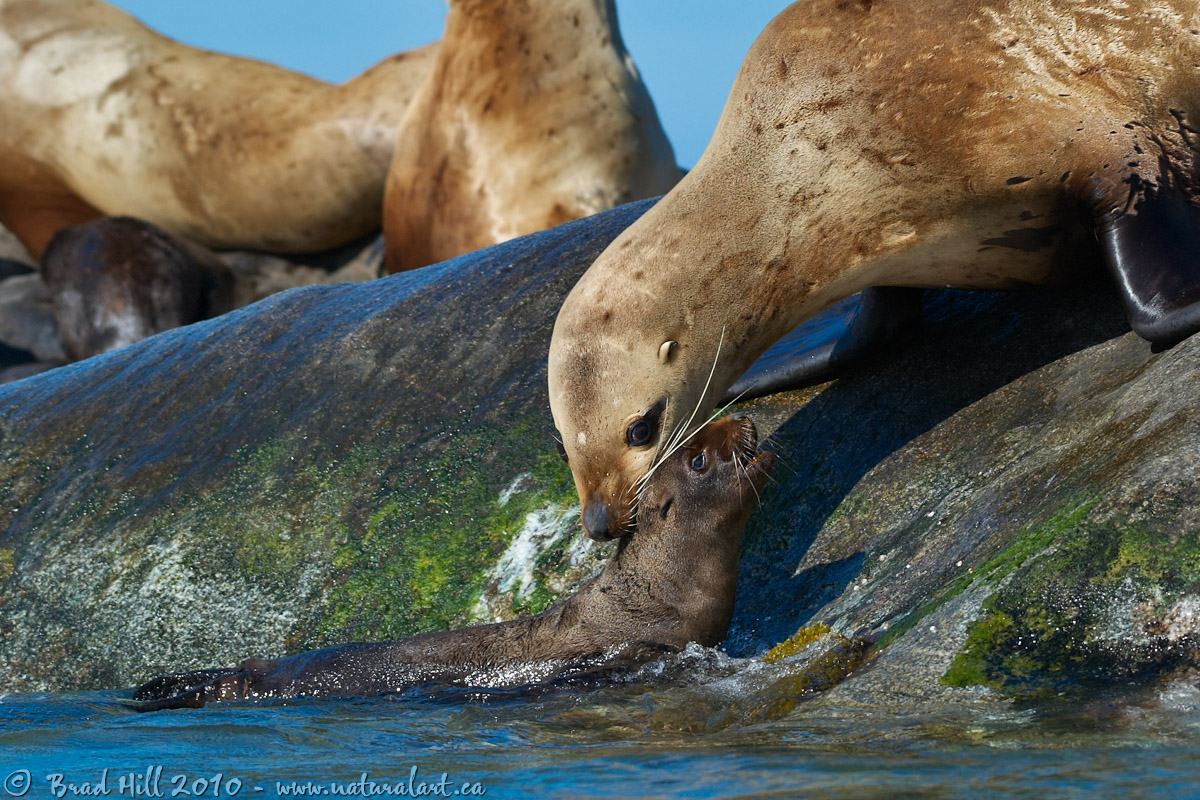
This is an image of a female Steller's Sea-Lion not-so-gently grabbing and hauling one of her offspring out of the ocean and onto a slippery rock after a large male had unceremoniously knocked the little tyke into the sea. At the time there was a lot of commotion around the area, with gulls, cormorants, and many tons of sea-lions adding to the confusion. Despite all the craziness, ma kept an eye on her pups (there were 3 that appeared to be hers) and made sure they were all safely placed on the rock. Talk about a powerful maternal instinct!
I shot this image with Nikon's popular 200-400mm f4 zoom VR lens. Like the 70-200 f2.8 VR, the 200-400 offers two VR modes: Active and Normal. I've talked to many photographers about this lens and there seems to be some confusion as to when they should select each mode. My experience with both the 70-200 and the 200-400 confirms what the manuals say if you read them carefully - if you're shooting from an unstable surface (i..e, you're not on firm ground) you should choose the "Active" mode. This is because the Active mode senses and tries to cancel movement in all planes, which is what happens when you're shooting from a moving car or, in this case, from an inflatable Zodiac boat that was bobbing in the ocean.
You'll find some photographers/authors who claim that there is no advantage to using your lens's VR mode at shutter speeds of 1/500s or faster. This may be the case in some situations, but it overlooks the fact that the VR may help you keep your subject within your frame, especially if you're using the "Active" mode. In this case we were bobbing so much that the only way I could keep the two subjects in the frame and focus on them was to switch to Active VR mode. While theoretically the image may have been sharp without the VR (it was shot at 1/1250s), I doubt I would have been able to focus on the critical head region without the VR.
Just another little "real world" tip to slot into your gray matter ;-)
By the way - about the title: The rocks that sea-lions (and seals) climb onto to rest are technically known as "haul-outs", thus the play on words in the title.
Subject: Steller's Sea-Lion (
Eumetopias jubatus) - female with pup
Location: Gwaii Haanas National Park, Haida Gwaii, BC, Canada
Camera: Nikon D3s
Lens: Nikkor 200-400 mm f/4 VR zoom lens at 210mm - handheld from floating Zodiac boat. VR on and in "Active" mode.
Exposure: 1/1320s at f6.3. ISO 320. -0.33 stop compensation from matrix metered exposure.
Crop: Significant - this is only about 65% of the original capture
All the contextual information surrounding this shot (field notes, all camera settings and processing details, conservation, etc.) can be found at:
http://www.naturalart.ca/galleries/latest/detail_2.html.
Comments and feedback greatly appreciated...probably better to view larger version prior to doing so...
Cheers...
Brad

Comments
7 commentsAnother great capture that has many of the elements needed to take it beyond a shot. There is a wonderful behavior that is captured in this image along with eye contact with both subjets, no distracting elements (the OOF seal lions are wonderfully blended) and you have the crucial elements showing (algae covered rock, steep slope, water). The only nit is a desire for slightly more room on the left.
- Luke