Hey all,
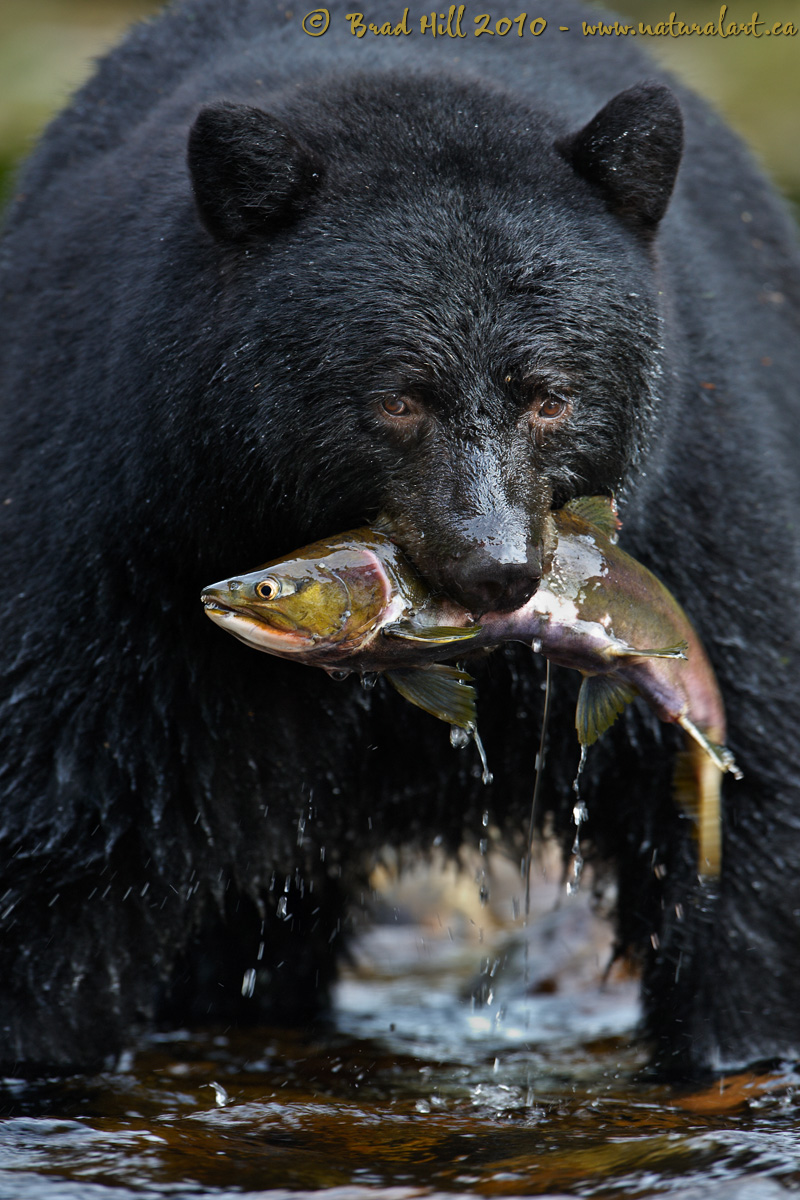
I'm off to Haida Gwaii (formerly called the Queen Charlotte Islands) on Thursday for a few weeks of shooting so this will be my last image posted for awhile. The Haida Gwaii have no grizzlies, so I thought it would be appropriate to post this shot of a black bear (which ARE found on Haida Gwaii)...
This was a very tough shot to create. On average, I find Black Bears trickier to photograph than Brown (or "Grizzly") Bears, largely because it can be very challenging to get the exposure right and ensuring that the subtle black-on-black detail is retained. Commonly when photographing Black Bears (or any other dark objects that are filling your frame) it's best to slightly over-expose the image (relative to what your light meter is telling you) to capture the full tonal range of their "black-on-black" coats. But in this shot getting the right exposure was even tougher - the reflected highlights on the "wet bits" (including the bear's snout, the salmon, and the water below the bear and between its legs) really complicated things. Any over-exposure of this scene would have lead to a major blowout of highlight details that could not have been retrieved. To "solve" the problem of potentially blown highlights I did two things: I used a circular polarizing filter to cut some of the glare of the reflections and I exposed to
just retain highlight detail (which, in this case, meant a slight UNDER-exposure, despite the darkness of the subject). The resulting raw file appeared to have BOTH blown highlight detail and lost shadow detail (this scene had a huge brightness/dynamic range). But, when I looked at my histogram I was quite confident I had enough "headroom" in the file to retrieve both the highlights and the shadows. This is definitely an example of where my processing experience with files specific to the camera I used influenced how I chose to capture the image (i.e., I had to know how much shadow detail AND highlight detail I could actually retrieve from a D700 file without introducing noise). I daresay this is an image that could NOT have been effectively captured as a JPEG file (at least with current technology).
Besides being a good example of a "shoot-to-process" capture, this is one of those rare images where the photographer (me) actually likes the result! I like this image both as a photographer and as a biologist. As a photographer I like the image on two levels. First is simply the drama and action (and the fact that both the eyes of the bear and the eye of the salmon are in focus!). Plus, from a compositional perspective there's a subtle repeating pattern that appeals to my eye (and is what caught my eye when I was culling the images and saved it from the trash bin). I'm referring to the repeating pattern of curves and arches, including the arching "tunnel" between the bear's legs,the curve of the fish, the curve at the top of the bear's head, the arch of the bear's forelegs, and, finally, through to the arch of the backside of the bear.
As a biologist I like the image because it nicely illustrates the role of bears (both black and brown) as keystone species in coastal regions. Keystone species are those which play an ecological role that is disproportionate to their numbers (or biomass) in the ecosystem. In other words, they have a disproportionately large role in influencing the composition of the other species in the ecosystem. While this bear is obviously having an impact on the future of THIS fish, what isn't shown here is what happened AFTER the image was shot and how it impacts on the "big picture" (i.e., the ecosystem). And that event was the bear disappearing far into the forest and munching on the fish. This act - taking the fish off into the forest and leaving its carcass there - plays a huge role in getting nitrogen FROM the fish INTO those massive trees of the Great Bear Rainforest. Studies (tracing the isotopes of nitrogen found in salmon) have shown that a major source of nitrogen in the trees come from the salmon - with the bear unwittingly acting as the diligent forest fertilizer! Take the bears away and the trees lose their furry fertilizing agents and the forest changes in structure. Cool, eh?
Subject: Black Bear (
Ursus american kermodei) with slippery prize
Location: Northern BC Coast (Great Bear Rainforest), Canada
Camera: Nikon D700
Lens: Nikkor 600 mm f/4G ED-IF AF-S VR lens - handheld. VR on and in "Normal" mode.
Exposure: 1/160s at f5. ISO 720. -0.33 stop compensation from matrix metered exposure.
Crop: Very small - this is about 95% of the original capture
All the contextual information surrounding this shot (field notes, all camera settings and processing details, conservation, etc.) can be found at:
http://www.naturalart.ca/galleries/latest/.
Comments and feedback greatly appreciated...probably better to view larger version prior to doing so...
Cheers...
Brad

Comments
25 commentsA very cool shot with a nice mix of sharpness and blur. The detail and subtle colors in the fish are amazing. You mention seeing the histogram and feeling you had enough "headroom". Can you post a screen shot of the histogram before and after? I think that would help some of us (me anyways) to visualize it and be able to apply it in the field (or at the computer). Thanks.
- Luke
I would like to underline that we appreciate very much the explanations you provide with your images.
Thank you and congrats
D&L
Cheers...
Brad
Laura Stafford
The mentoring you provide here in fauna is remarkable.
The images, eye candy!
Have a great trip!
Neil
Coming back to picture, I just love the fish ...shining like a diamond here and the details on bear.
I may prefer to tone down slightly, the bright space between the legs, just to retain the low key effect and let the bright n colourful fish grab all the attention.
Have a great trip!
Jagdeep Rajput
Thanks for the positive feedback on my postings (and this image). To me it's worth it to take the time - I firmly believe in sharing information and not "holding back" information in the fear of being scooped (which I've always thought was totally ridiculous...but whatever!). I'm glad y'all appreciate the effort!
Vincent - you said:
.
Cripes...I was kneeling in the water with the bear when I took this! I guess the next step is an underwater housing (which I recently picked up by the way...). Sigh...
Cheers...
Brad
I did not say it would be easy Brad. Just keeping you on your toes and helping you achieve 'impossible' images.
So - guessing we'll soon be seeing over/under shots with salmon below and bears above right?
Ken Archer
Edwin Kats
Such a wonderful shot!
- Zaid