Dark-eyed Junco
by Ronnie Gaubert
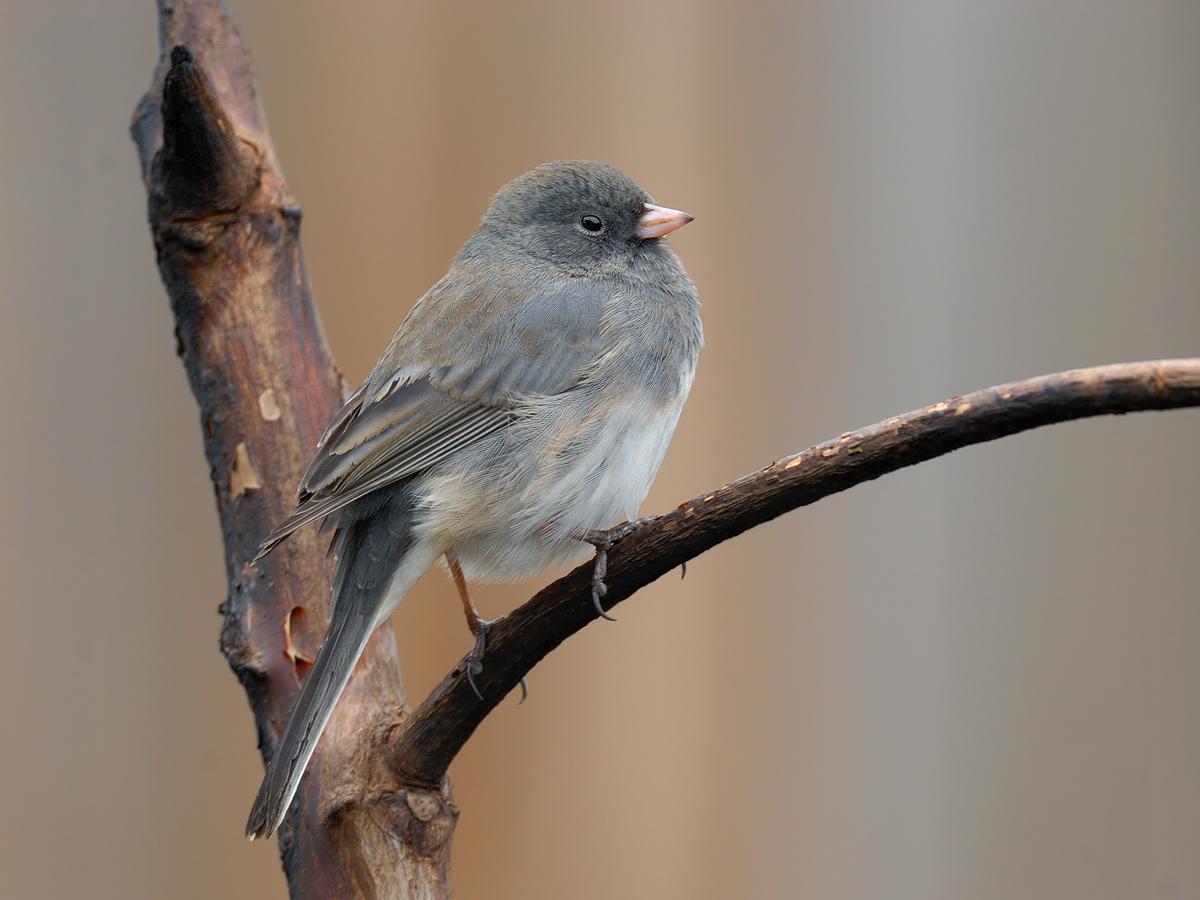
My first sighting of a Dark-eyed Junco. It doesn't have the dark feathers on the top side. Must be a juvenile???
This image was taken in my backyard. I have a small area towards the rear of my property that I leave for nature. I have a plant called Cypress Vine, (Ipomoea quamoclit). It produces thousands of small black seeds that fall to the ground all summer and fall. I had been seeing this lone Junco for about a week. She was always feeding on the ground, feasting on those Cypress Vine seeds. One late winter afternoon I noticed her perched on this dead plant. This was not a set-up shot with a set-up perch. I watched her for a minute or so and thought to myself, if I go inside and get my camera she will be gone when I return. So what the heck, I went grab my gear which took a couple of minutes. To my suprise she was still there when I returned. Now I'm thinking she will never allow me to get close enough for a shot. I was out in the open and nothing to hide behind. I slowly approached and got closer and closer. The first time I set my tripod down I was closer than minimum focus of my 500mm. Backed up about a foot and she remained there for another 1-1/2 minutes according to my EXIF data. This was the best of the bunch regarding head turn and sharpness. The light was low with heavy clouds and late in the day. Taken a few days before Christmas.
Full Frame with a 3x4 format.
Ambient light only
Background: Neighbor's Fence
Tripod
1.7x teleconverter
Model: Nikon D200
Flash Used: No
Focal Length: 850mm (Nikon 500mm f/4 VRII + Nikon TC17EII)
Exposure Time: 1/60th
Aperture: f/8 (stopped down 1/2 stop)
ISO Equivalent: 400
Exposure Bias: "0"
White Balance: Manual Direct Sunlight
Metering Mode: Matrix
Raw
Exposure Program: Aperture Priority

Comments
12 commentsThe Dark-eyed Junco is a complex species, with a lot of regional variation. When I started birding in the early 1970's there were Slate-colored Juncos in the northeast, White-winged Junco in the Dakotas, and Oregon, Pink-sided, and Gray-headed Juncos in the west. All of those are considered regional forms of Dark-eyed, and there can be intergrades of most of these. I would guess that your bird could be a blend of pink-sided and slate-colored as I wouldn't expect to see any juvenal plumage at Christmas.
The Dark-eyed Junco is a highly variable species. Ornithologists get into shouting matches about subspecies. Over the years, there have been splits, lumps, re-splits and re-lumps. Birds of North America says, "Junco populations differ in plumage and bill color, migratory behavior, and body size. This variation is responsible for a 'turbulent' taxonomic history and a reputation as a 'nightmare' for systematists." There are five groups, but beyond that it gets awkward.