I've just returned from leading my annual
"Grizzlies of the Khutzeymateen" Instructional Photo Tour. As always, the trip was a resounding success and all participants (including me) returned with cherished memories (and a few photographs, of course!

).
Because I already have thousands of bear images, I decided to do a few things differently on my Khutzeymateen trip this year. I resisted the urge to go the easy route and forced myself to shoot prime lenses almost exclusively - and primarily my newish 400mm f2.8 VR. There's no doubt in my mind that if you're a Nikon shooter the single BEST lens to take into the Khuzeymateen is the very popular 200-400mm f4 VR, but I really wanted to see what my fast prime 400mm VR could really do (both "native" and with the 1.4x and the new 2x teleconverters). And, I wanted to push my D3s to see what it could really do, especially in the high ISO end.
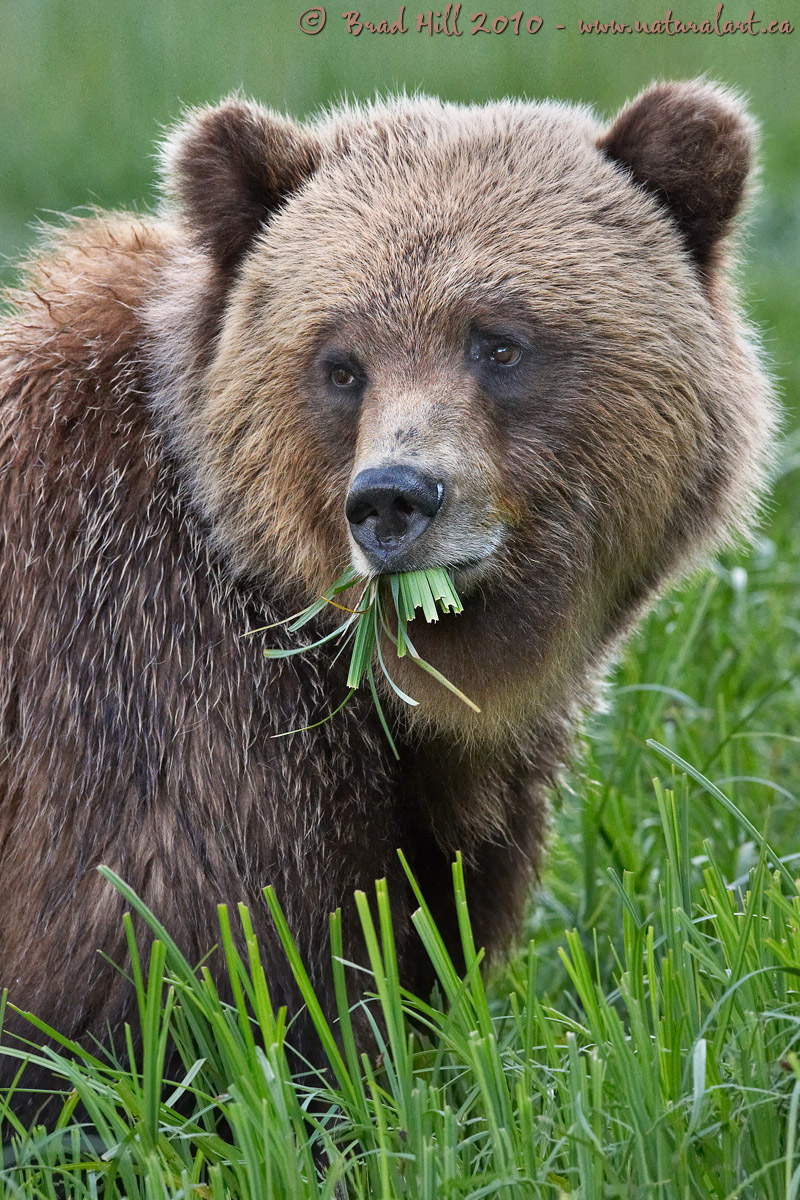
I nabbed this image after the sun had gone behind a mountain and light was faltering. The bear is a 4 or 5-year old female grizzly with a beautiful blond face. She was very approachable and, as a matter of fact, because she's approaching breeding age and there were several uhhhh...well...amorous...males around, she seemed most relaxed when she approached US (apparently we were less scary for her than the big male bears). I was quite close to this female when when I shot this (it's virtually full-frame) with my 400mm lens. Between my proximity to the subject (with the associated need to stop down to get the critical portions of the bear and foreground in focus) and the fact that I needed a fairly high shutter speed to get a sharp image with the very weighty lens I was hand-holding, I decided to just let the ISO go! So...waning sunlight and I'm shooting a long lens stopped down to f11 at a shutter speed of 1/1000s. The ISO? Are you sitting down? ISO 12,800. AND, most critically, I have performed NO noise reduction on this image* other than the default values on my raw converter. While the background has SOME discernible noise, it's very minor and could be handled in seconds with any number of noise reduction products (Noise Ninja, etc.). To say that I was shocked by the quality of the output is an understatement!
When I talk to many nature photographers they often tell me they don't often shoot in low light and thus don't need one of the new full-frame high ISO wonder machines (and they often say they can't "afford" to lose the 50% increase in effective magnification when going from a cropped sensor Nikon to a full-frame one). But what I think they're really missing out on is that having a camera that can perform well at high ISO settings gives you SO MUCH MORE CONTROL OVER YOUR APERTURE (and depth of field), which is one of the few things wildlife photographers can control in a field setting. Plus, it ends up being a whole lot easier to get to shutter speeds where you can hand-hold big lenses that you couldn't before. If I was limited to ISO 800 (or even lower) when capturing this shot I likely would have had to open up the aperture so much that I would have been struggling to keep both the eyes and nose in focus (and I couldn't even have dreamt of keeping that foreground sharp).
Subject: Adult female grizzly (
Ursus arctos) chowing down after sunset
Location: Khutzeymateen Inlet, BC, Canada
Camera: Nikon D3s
Lens: 400mm f2.8 VR - hand-held
Exposure: 1/1000s @ f11; ISO 12,800; -0.3 stop exposure compensation from metered exposure setting.
Crop: Negligible. This is about 90% of full fram
All comments and critiques welcome, but probably better to view larger image first. Bear in mind (pun intended) this was simply a test shot to see what I could get from ridiculous ISO settings...
Cheers...
Brad
*NOTE: The act of reducing an image in size and resolution inherently removes some image noise. Slighly more noise is visible in the larger version of this image (click on the main image to see the largest version), but even the full-frame image is remarkable noise-freee. Feel free to contact me if you like me to provide you with a full resolution version of the image to assess image noise.

Comments
20 commentsAt any rate, Welcome back, Brad!
This is a stunning example of the possibilities for the latest batch of sensors. Not to diminish talent, but this opens the possibility of shooting in available darkness
Looking forward to more (not test) images from your trip.
Neil
Looking forward to see more from your tour.
D&L
Glad you made it back alive! This is really impressive not both technicaly but the image as well. Such an innocent amusing expression with the grass hanging out of the mouth it surely would have been a treat to experience this. Imagine the detail you could have gotten on the face with the 2X attached!
I have two questions:
1: what role does the lens play in noise on an image like this (obviously f/stop plays a role with its involvement in SS and need for higher ISO)
2: what is the colored splotch directly to the right of the nose and under the right eye? Is it a grass stain?
- Luke
No problem making it back alive - had my most dicey bear encounter ever yesterday - once I was home (try controlling two dogs when you've accidentally and simultaneously stumbled on a coyote den full of pups and and angry mom and then a mad mother bear with two cubs climbs down a nearby tree - sheesh!! And yes, I did get charged by ma bear. I have to go back to the grizzlies where it's safe!!).
You asked:
I'm not sure what role the lens plays in directly affecting noise - seems to me that the noise is a function of turning the "gain" up and amplifying both the weak signal and the fixed amount of noise per photosite. I can't think of a reason why the lens's sharpness or resolving power would have any affect on this. But if anyone else can come up with a reason I'm all ears. If I'm missing the gist of your question let me know...
And you asked:
This is easy: Yep - grass stain.
Cheers...
Brad
D3s is indeed setting very high standards and I think its time for me to switch over to Nikon now.
Well done.
Upjeet
Nick Bristol
Lone Rock, Wi
I like the shot as well - the grass is a real bonus. I'd prefer to see a little more space on the left, but that's hardly a nit. Thanks for sharing!
This is an amazing shot! The camera you're using is just an amazing piece of equipment! I really love your posts!
- Zaid