expired giant (+ other POST)
by Stuart Williams
Along the southern Mozambican coast, between Baia dos Cocos and Tofo, lies a stretch of reefs that are important for whale sharks, the (relatively newly named) reef manta rays, Manta alfredi, and giant manta rays, Manta birostris. These animals congregate to feed on the plankton that is rich in these waters.
One of the consequences of this congregation has been a rapid rise in tourism in the area. Despite this, a fishery has also developed in the area for mantas for local and export trade, particularly for fins, skins, liver, meat and brachial filaments. Indeed, it is the fishing for brachial filaments - which are dried and exported to the Asian medicinal market - that may be the primary driver of the expansion of this fishery. Not only are local (subsistence) fisheries switching to kill mantas for parts to export to this insatiable market, but outsiders are also coming into the area to cash into the fishery.
Mantas are large, long-living, slow-reproducing animals. They are known to live for more than 20 years, they grow up to 1,350kg, they have a 12-month gestation that results in the birth of one or, occasionally, two pups and they have an interbirth interval of two to three years. As such, they are vulnerable to these fishing pressures. A population of mantas can be snuffed out by only the briefest puffs of human pressure.
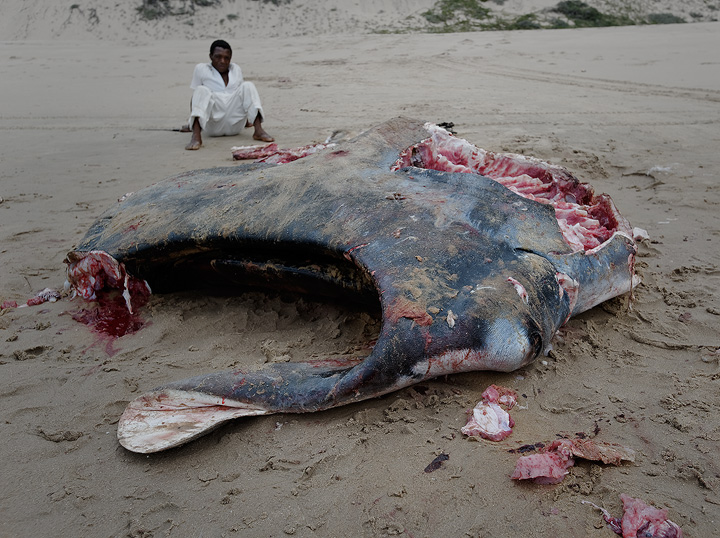
This large manta was killed at Baia dos Cocos - just 4km from the famous 'manta reef' dive site (where one may see mantas aggregate at 'cleaning stations'). The animal was rapidly chopped up; see below for other image from this occasion).
Thanks for looking.
D700, 17-35mm @ 30mm, f/8.

Comments
6 commentsIts interesting that this was taken so close to a manta dive site. These animals are worth so much more alive (sustainable ecotourism), yet ignorance, poverty, and increasing human population are really putting pressure on what you rightly term a slow-reproducing animal.
Its hard to take a 'flattering' photo of a scene like this. However, I do note that the contrast seems a tiny bit flat. Thanks for posting.
Thanks Daniel and Cindy for your comments.
If you wanted to "perk these up" contrast-wise, experiment with the black slider in each of the color panels in Selective Color adjustment in Photoshop. I'm guessing all that will be needed are the white, neutral and black channels, but interesting things could be done in the red and either the blue or cyan, depending on your tastes.
Great work!
Sansy r