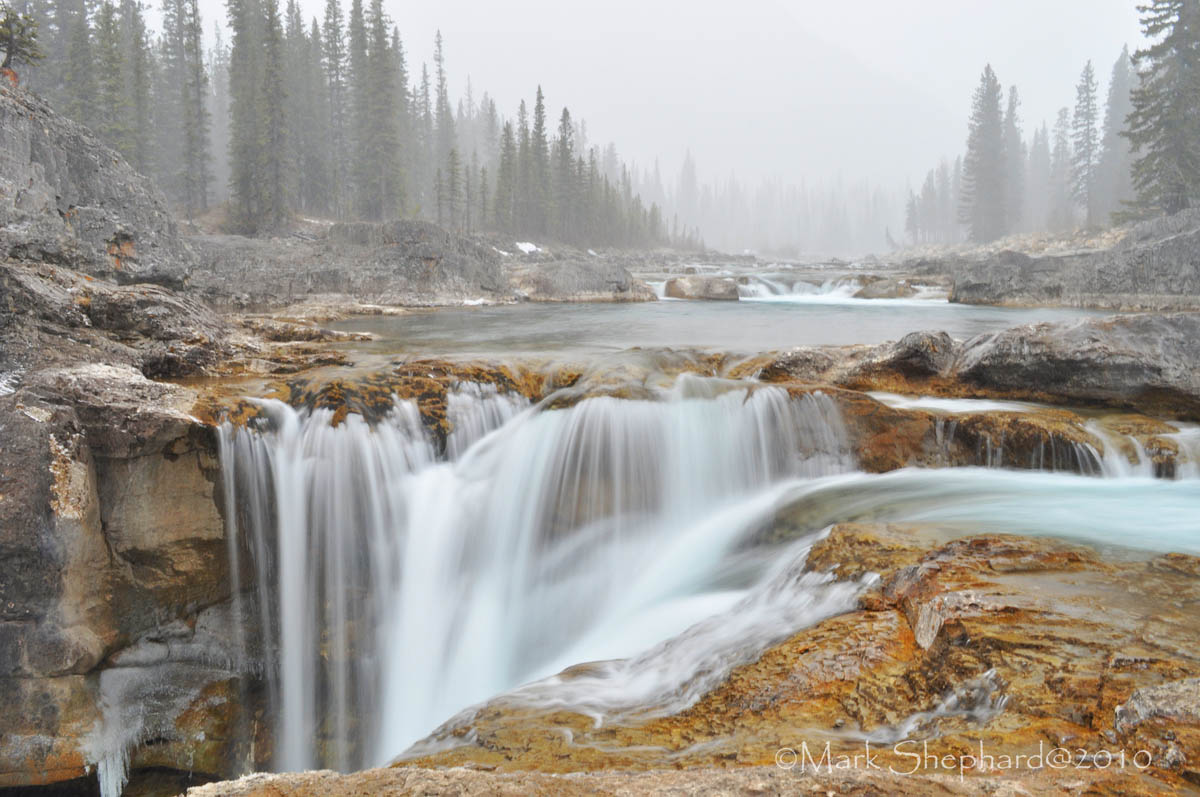
Elbow Falls
by Mark Shephard
This was one of those weekends in the mountains where everytime I even thought about getting my camera out of the bag it would start to snow. I never use bad weather as a reason not to get out and take some shots and this day was no different...I took hundreds. Its just another learning experience along the way. This is the first time I've slowed the shutter speed down to get this water effect and I had some challenges in doing so. I'm sure this is where a Neutral Density filter would come in handy and I am in the process of researching and getting ready to order a set. I'm just not sure of which filters are the most useful...ie Hard or soft or how many stops in density. Any suggestions would be gratefully appreciated. Thanks for stopping by to take a look.
As always your thoughts and comments are welcome and appreciated.
Nikon D5000
f/25 @ .7 secs
ISO-200

Comments
9 commentsRegarding the ND filters you can try to simulate them in software (Lightroom, PS maybe ?) or try to take 2 exposures (usually one for sky and one for darker areas) and blend them using the PS. There is also couple of methods of blending these images.
Anyway probably most of the people ? (as I am) still use the ND filters or use them with that blending combination to better control the exposure. Most useful are probably all of them - or at least hard to say for me as you will use different ones for different shots. The "hard" ones has the "hard" transition so they are quite useful when you have the horizont clearly defined. The soft ones are quite handy in other occasions. As well the density depends on the intensity of the light and you can combine them.
There are also quite special ones as well for example Singh-Ray reverse graduated one which means that you have that "dark" part in the middle what is very handy when you are taking the pictures of the sunset or whatever.
I would recommend some reading about these and you can get quite good idea which ones use when.
Hope it helped at least a little bit.
Here are couple of links:
http://singhray.blogspot.com/2010/03/essential-filters-for-controlling.html
http://singhray.blogspot.com/2009/04/filters-holders-and-vignetting-building.html
http://www.naturephotographers.net/dw0502-1.html
Try not to use this kind of aperture (f/25) because of difraction, it's better to shoot at f/16-f/18 range. On the other hand I see a little bit overexposed so try to reprocess and sharpen more.
It is a pity that you hadn't a GND because you could get the fog texture in the background!!!
Best regards
About the GND's: I find myself using the as "GND" less often now as the mountains I'm in often don't really work well with the straight transition on the filter. Switching to several exposures proofed to be much more efficient. I suggest you buy a 0.9 Hard GND - but buy a big one like 100x150mm. You can use it as a GND and - what might be useful for you - as a ND as well just by holding the darker part in front of the lens. I do this then and now and the filters are big enough to make this possible. You could add a 0.6 Hard GND to that for more flexibility.
I use Lee Soft GND's, since rarely do I shoot a scene that has a clear straight transition line. But this same affect (as mentioned above) can be re-produced in PS using 2 images and a gradient mask.