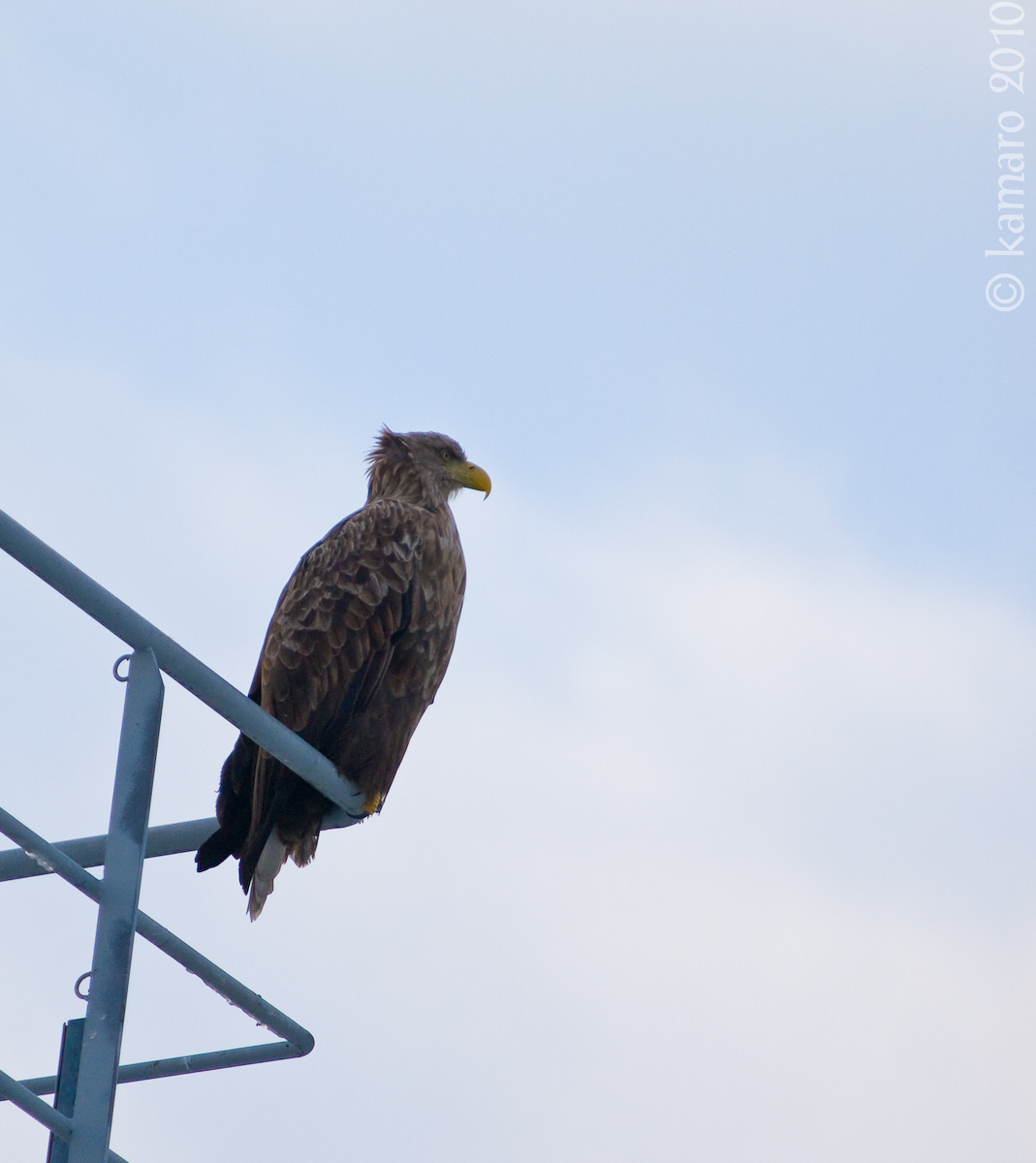
My first Avian post, and actually, my first 'real' avian photo, so please don't thrash it, ok?

The backlight was quite bad, so the picture is a bit dark; this is about as much as I could tweak it in PP.
It wasn't really my intention to go and shoot big predators with my brand new lens (which I got thanks to some advice from NPN'ers), but I got damned lucky. I had just ordered my lens when my Mother told me about this White-tailed Sea Eagle (Haliaeetus albicilla) that had been visiting the harbour area this winter. So once I got the lens, Mom took me there (the area's closed to the public, but she works there as a crane driver). We didn't see the eagle (my usual luck, no surprise there), but ok then, I could try the zoom on the scenery. I was just putting up my tripod, when one of Mom's workmates appeared. Hearing what we were about, he pointed and said: "The eagle's over there!" We'd never have spotted it ourselves! So there you go, my first avian subject.
Despite the obvious lack of mm's and the backlight, I'd have been happy simply *seeing* the bird, as they're rare enough in the best of places.
Thank you for looking.
Olympus E-3
Zuiko 50-200 mm SWD + TC 1.4x @ 283 mm
1/1000 sec @f5.0
ISO 400
Dodgy tripod, no flash
PS. I'm a bit new to this zoom & TC business, so could someone please explain why the camera data says 283 mm, even though the theoretical maximum with this combination is 280? Surely there can't be such a thing as a free mm?


Comments
7 commentsNice work finding the eagle, I'd have been very happy just to see the bird too, getting an image of it is a bonus.
I can't explain why the camera data says 283mm, perhaps some one else can.
I might have tried some positive EV compensation since the bird was backlit, some times even +1/4 to +1/3 can be an enormous help in the exposure.
This image shows this species huge bill, that is very impressively large!
That is one impressive Eagle!
Hope you become a regular here on Avian.